🔴Illinois HB 3773IN EFFECTUp to ~$70K/violation|🔴Texas TRAIGA (HB 149)IN EFFECTAG-enforced|🔴Utah AI Policy ActIN EFFECT$2,500/violation|⚠️Colorado AI Act (SB 205)Jan 1, 2027AG-enforced|⚠️California SB 942Aug 2, 2026$5K/day|⚠️EU AI Act Art. 50Aug 2, 2026€35M or 7% revenue|⚠️New York RAISE ActJan 1, 2027AG civil penalties|🔴Illinois HB 3773IN EFFECTUp to ~$70K/violation|🔴Texas TRAIGA (HB 149)IN EFFECTAG-enforced|🔴Utah AI Policy ActIN EFFECT$2,500/violation|⚠️Colorado AI Act (SB 205)Jan 1, 2027AG-enforced|⚠️California SB 942Aug 2, 2026$5K/day|⚠️EU AI Act Art. 50Aug 2, 2026€35M or 7% revenue|⚠️New York RAISE ActJan 1, 2027AG civil penalties|
Last checked today🕐 29 Jul 2026, 00:38 UTC12 of 27 tracked Missouri records re-checked · last change Apr 29, 2026ago.mo.gov
No LawDeadline: N/A
Flag of Missouri

AI Laws in Missouri (MO)

No state-specific AI law. Federal laws apply. Missouri AG monitors AI-driven consumer protection violations under the Merchandising Practices Act.

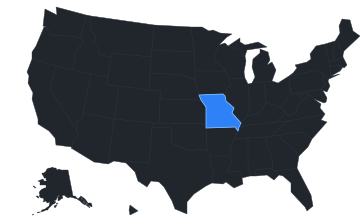
Map showing the location of Missouri in the United States
Missouri within the United States

What companies in Missouri need to know about AI compliance

As of 2026-04-29, Missouri has not enacted an AI-specific statute; the Missouri Attorney General office defers to no comprehensive state privacy statute; UDAP coverage via Missouri Merchandising Practices Act (Mo. Rev. Stat. sec. 407.020). Operators across sectors in Missouri watch federal signals first.

Three neighboring regimes create compounding exposure: Illinois (HB 3773 — AI in Employment (amends the IL Human Rights Act), penalty IDHR/IHRC make-whole relief + tiered civil penalties up to ~$16,000–$70,000 per act per aggrieved party), Kentucky (AI Study Resolution, penalty TBD), and Tennessee (ELVIS Act — AI Voice/Likeness, penalty Civil damages). Multi-state Cross-Sector operators headquartered in Missouri default to the strictest stack.

Federal law still governs Cross-Sector AI in Missouri primarily through FTC Section 5 (15 USC 45) and NIST AI RMF 1.0. Adjacent federal authorities include Gramm-Leach-Bliley Act (GLBA) / NIST Cybersecurity Framework (15 U.S.C. § 6801-6809; NIST CSF 2.0); General Data Protection Regulation (GDPR) (for EU users) (EU Regulation 2016/679); Section 508 / ADA Title III (Digital Accessibility) (29 U.S.C. § 794(d); 42 U.S.C. § 12181). Gramm-Leach-Bliley Act (GLBA) / NIST Cybersecurity Framework (enforced by Federal Trade Commission; NIST) applies to saas platforms handling personal/financial data via ai must implement nist csf security standards: identify, protect, detect, respond, recover. Penalty exposure: ftc civil penalties up to $100,000/violation; private litigation for data breaches. FTC Operation AI Comply (Sep 2024) targeted five companies across sectors.

The practical effect for Missouri operators: AI compliance risk is driven by federal agencies first, with Missouri Attorney General acting on UDAP residual authority only when consumer harm surfaces.

The federal and neighboring-state framework that governs your AI operations. Cross-Sector operators in Missouri operate under a federal-dominant framework anchored by FTC Section 5 (15 USC 45) and NIST AI RMF 1.0, with adjacent authorities Gramm-Leach-Bliley Act (GLBA) / NIST Cybersecurity Framework (15 U.S.C. § 6801-6809; NIST CSF 2.0); General Data Protection Regulation (GDPR) (for EU users) (EU Regulation 2016/679); Section 508 / ADA Title III (Digital Accessibility) (29 U.S.C. § 794(d); 42 U.S.C. § 12181). FTC Operation AI Comply (Sep 2024) targeted five companies across sectors. The practical risk they have to price in is cross-sector FTC Section 5 exposure and state UDAP liability, and the bellwether signal to monitor is NIST AI RMF 1.0 (Jan 2023) is cited as the federal baseline across 30+ agency guidance documents. Illinois -- HB 3773 — AI in Employment (amends the IL Human Rights Act) sets the de-facto regional floor. Missouri has considered AI-liability and deepfake bills (e.g., HB 1462, the AI Non-Sentience and Responsibility Act, 2025) but enacted no comprehensive AI statute; it tracks neighboring Illinois HB 3773 and regional AI working groups. Use this as a starting point; sector pages on this site go deeper into industry-specific obligations.

With 11-50 employees you can justify a half-time compliance lead and part-time external counsel on retainer. Small-stage Cross-Sector operators should deploy a named compliance lead, formal AI inventory, quarterly bias spot-checks, and a documented escalation path, with semi-annual internal audit with annual external review and ownership resting with a designated AI compliance lead reporting to the CEO. small-business budgets ($50K-$250K) justify a compliance lead plus a GRC tool such as Credo AI, Fairly, or Holistic AI. For Cross-Sector specifically, the sharpest exposure to manage is cross-sector FTC Section 5 exposure and state UDAP liability. Given Missouri's concentration in transportation logistics, financial services, and healthcare, freight-routing algorithms, consumer-lending models, and rural telehealth AI deserve priority in your AI inventory.

The enforcement surface for Cross-Sector centres on FTC, CFPB, State Attorneys General, and the statute operators most often under-document is General Data Protection Regulation (GDPR) (for EU users) (EU Regulation 2016/679) — a gap that surfaces in cross-sector FTC Section 5 exposure disputes. Build an evidence binder covering AI inventory, risk-tier register, incident-response runbook, and board-level AI risk report. Treat NIST AI RMF 1.0 (Jan 2023) is cited as the federal baseline across 30+ agency guidance documents as your leading indicator and escalate when the signal shifts.

Verified 2026-04-29. See https://ago.mo.gov/ for the Missouri Attorney General public record on Missouri AI policy.

Even without a Missouri-specific AI law, federal enforcement from the FTC, EEOC, CFPB, and HHS applies to AI-driven decisions in your state. The in-force federal framework is set out below; the industry pages further down cover sector-specific obligations.

No state AI law — but this federal framework still applies in Missouri

Missouri has not enacted its own AI-specific statute. That does not mean AI is unregulated here: the U.S. federal framework below is in force in Missouri exactly as it is in every other state. Each authority links to its official government source. This is the cross-sector baseline — see the federal AI tracker for bills moving through Congress, and the industry pages below for sector-specific obligations.

Last verified · Jul 5, 2026Sourced from official primary sources (linked below).
FTC Act Section 515 U.S.C. Section 45(a)
Enforced by Federal Trade Commission

Prohibits unfair or deceptive acts or practices in or affecting commerce. AI-generated marketing content that deceives consumers — synthetic testimonials, undisclosed AI-created imagery, deceptive personalization, dark patterns amplified by AI — is actionable under Section 5.

Penalty exposure: Civil penalties up to $51,744 per violation (2024 CPI-adjusted); consumer redress; disgorgement; algorithmic model-deletion remedies as in the Rite Aid and Everalbum orders
EEOC Technical Assistance on AI and Title VII (May 18, 2023)EEOC, Assessing Adverse Impact in Software, Algorithms, and Artificial Intelligence Used in Employment Selection Procedures Under Title VII of the Civil Rights Act of 1964 (May 18, 2023)
Enforced by Equal Employment Opportunity Commission

Applies the Uniform Guidelines on Employee Selection Procedures four-fifths rule to AI hiring tools. Employer is liable for discriminatory AI outputs even when the tool is built and operated by a third-party vendor.

Penalty exposure: Title VII remedies: back pay, compensatory damages, punitive damages up to $300K per claimant (employer-size tiered caps), injunctive relief, attorney fees
Enforced by Equal Employment Opportunity Commission

AI hiring and performance monitoring systems must accommodate individuals with disabilities. Must not eliminate essential job functions or require unnecessary testing.

Penalty exposure: Compensatory and punitive damages; back pay; injunctive relief; up to $100,000 in civil penalties
Enforced by Federal Trade Commission; Consumer Financial Protection Bureau

AI credit and background check systems used in rental decisions must be transparent and non-discriminatory.

Penalty exposure: Actual damages or $100–$1,000 per violation; Class action liability
NIST AI Risk Management Framework 1.0NIST AI 100-1 (Jan 26, 2023)
Enforced by National Institute of Standards and Technology

Voluntary framework organizing AI risk into Govern, Map, Measure, and Manage functions. A manufacturing-focused profile is under development. Framework is referenced in federal-contractor expectations and in agency best-practice guidance.

Penalty exposure: Not directly enforceable; cited in regulatory actions, contract requirements, and standard-of-care determinations in tort litigation
This is a cross-sector summary, not an exhaustive list. Federal coverage evolves — always confirm current requirements against each official source above and the federal AI bill tracker.
✓ Free · No email · 2 minutes
Does your Missouri business comply with AI laws?
Answer 4 quick questions → get your personalized risk score + action list.
Check My Risk — Free →
● Live

Recent AI law developments in Missouri

Updated July 27, 2026

Recent news coverage of AI regulation and policy in Missouri. Headlines are aggregated automatically; follow each link for the full story.

Senators Probe Sonderling on AI , Ethics , Workforce Development Partnershipalanclarkdesign · CC BY-ND 2.0 · via flickr
Senators Probe Sonderling on AI , Ethics , Workforce Development Partnership

Coverage from plansponsor.com on AI legislation and regulation relevant to Missouri.

plansponsor.com·
Missouri governor praises AI economic advantages while dismissing data center concerns during remarks at public forumbugeaters · CC BY 2.0 · via flickr
Missouri governor praises AI economic advantages while dismissing data center concerns during remarks at public forum

Coverage from ky3.com on AI legislation and regulation relevant to Missouri.

ky3.com·
A city push for facial recognition on public buses ignites debate over security and privacystockcatalog · CC BY 2.0 · via flickr
A city push for facial recognition on public buses ignites debate over security and privacy

Coverage from clickondetroit.com on AI legislation and regulation relevant to Missouri.

clickondetroit.com·
Live · Legislature

AI bills moving through the Missouri legislature

Updated July 16, 2026

AI-related bills currently tracked in the Missouri legislature, updated automatically from Open States and the state legislature's own official record. Follow each link for the official bill text, sponsors, and status history.

HB 2239Creates the Artificial Intelligence Data Center Environmental Accountability Act

Referred: Emerging Issues(H)

Open States·
HB 1742Establishes provisions relating to companion chatbots

Referred: Emerging Issues(H)

Open States·
SB 841SS/SCS/SB 841 - This act modifies provisions relating to health care. AWARENESS DAYS (Sections 9.021, 9.025, 9.238, 9.412, 9.418, and 9.502) This act designates the last full week of September each year as "Frontotemporal Degeneration (FTD) Awareness Week" in Missouri. This provision is identical to SB 1709 (2026). This act designates the month of January as "Blood Donor Awareness Month" in Missouri. This provision is identical to SB 1328 (2026). This act establishes September each year as "Pediatric Cancer Awareness Month" in Missouri. This act designates each September as "Brain Aneurysm Awareness Month" in Missouri and the last full week of April each year as "Infertility Awareness Week" in Missouri. This act designates March 26 of each year as "Pediatric Acute-Onset Neuropsychiatric Syndrome (PANS)/Pediatric Autoimmune Neuropsychiatric Disorder Associated with Streptococcus (PANDAS) Awareness Day" in Missouri. This provision is identical to a provision in the perfected HCS/HB 2372 (2026). HOSPITAL INVESTMENTS AND SERVICE AREAS (Sections 96.192, 96.196, 206.110, and 206.158) This act modifies the investment authority of boards of trustees of municipal hospitals in third class cities and hospital district hospitals. Current law permits investment of up to 25% of funds not required for operations of the hospital or other obligations. This act permits investment of up to 50% of funds not required for operations or other obligations in a manner described in the act, with the remaining portion to be invested into any investment in which the state Treasurer is allowed to invest. These provisions shall only apply if the hospital receives less than three percent of its annual revenues from municipal, county, hospital district, or state taxes or appropriated funds from the municipality in which such hospital is located. Under this act, municipal hospitals in third class cities may operate in areas where hospital district hospitals and county hospitals operate. Hospital district hospitals may operate in areas where municipal hospitals in third class cities and county hospitals operate. These provisions are identical to provisions in SCS/HCS/HB 943 (2025) and SCS/SB 317 (2025) and substantially similar to the perfected SB 1019 (2026) and SB 244 (2025). EPINEPHRINE PRODUCTS (Sections 167.627, 167.630, 190.246, 196.990, and 321.621) This act changes "epinephrine auto-injector" to "epinephrine delivery system" throughout statute. These provisions are identical to the perfected HCS/HBs 1826 et al (2026) and similar to provisions in HB 165 (2025) and HB 553 (2025). COMMUNITY PARAMEDIC SERVICES (Sections 190.098 and 190.165) This act modifies provisions relating to certification of community paramedics and the provision of community paramedic services. Community paramedic services shall mean those services provided by an entity that employs licensed paramedics certified by the Department of Health and Senior Services as community paramedics, that is endorsed by the Department, and that provides services in a nonemergent setting, consistent with the education and training of a community paramedic and the supervisory standard approved by the medical director, and documented in the entity's patient care plans or protocols. Ambulance service shall enter into written contracts with another ambulance service provider to provide community paramedic services in that provider's service area. The Department shall establish regulations for the purpose of recognizing community paramedic services entities that have met the standards necessary to provide such services. The Department shall endorse such entities to provide community paramedic services for a period of 5 years. These provisions are similar to provisions in the perfected HCS/HB 2372 (2026), SCS/HCS/HB 943 (2025), SCS/SB 317 (2025), SB 548 (2025), SB 206 (2025), and SCS/SB 1382 (2024). SICKLE CELL STANDING COMMITTEE (Section 191.117) This act creates the "Lori Zena Baker Act". This act establishes the "Sickle Cell Standing Committee" as a subcommittee of the Missouri Genetic Advisory Committee within the Department of Health and Senior Services, with membership as specified in the act. The Director of the Department of Health and Senior Services shall appoint the committee members. The committee shall assess the impact of sickle cell disease on the state and make recommendations to the General Assembly and Governor regarding services and policies to address the state's needs, as described in the act. This provision is identical to SB 1735 (2026) and substantially similar to HB 1483 (2016). DOULA SERVICES (Sections 191.708, 208.662, 208.1400-1425, 376.1758, and 376.1765) This act creates the "Missouri Doula Reimbursement Act". Under this act, the chief medical officer or chief medical director of the Department of Health and Senior Services or the MO HealthNet Division of the Department of Social Services may issue nonspecific recommendations for doula services, a medical standing order for prenatal vitamins, or a medical standing order for a purpose promulgated in rule, to terminate as specified in the act. Additionally, this act adds doula services and childbirth education classes for pregnant women and a support person to the list of covered MO Healthnet and "Show-Me Healthy Babies Program" services, to be reimbursed as described in the act. The Department of Social Services shall study the impact of the childbirth education classes on infant and maternal mortality and shall submit a report to the General Assembly prior to January 1, 2028. These provisions are identical to provisions in the perfected HCS/HB 2372 (2026) and substantially similar to provisions HCS/SB 94 (2025) and HCS/HB 1095 (2025). Finally, the Department of Health and Senior Services shall review and approve doula registration for purposes of insurance coverage of doula services. Beginning January 1, 2027, every health carrier or health benefit plan shall provide coverage of doula services, except as otherwise provided. This provision is identical to a provision in the perfected HCS/HB 2372 (2026). TELEHEALTH (Sections 191.1146 and 334.108) Currently, the establishment of a physician-patient relationship for purposes of telehealth shall include an interview and a physical examination. Under this act, an evaluation is required, but a physical examination shall be required only if needed to meet the standard of care. Current law prohibits the use of an internet or telephone questionnaire completed by a patient from constituting an acceptable medical interview for the provision of treatment by telehealth. This act permits such questionnaires if the information provided is sufficient as though the medical evaluation was performed in person, with a report to be provided to the patient's primary health care provider within fourteen days of evaluation, as described in the act. Additionally, current law requires a physician-patient relationship for purposes of telehealth to include a sufficient dialogue with the patient regarding treatment. This act changes "dialogue" to "exchange" with the patient regarding treatment. Finally, current law prohibits a health care provider from prescribing any drug, controlled substance, or other treatment to a patient based solely on an internet request or questionnaire. Under this act, a health care provider shall not prescribe any drug, controlled substance, or other treatment to a patient in the absence of a proper provider-patient relationship. These provision are substantially similar to SB 108 (2025) and SB 851 (2024) and similar to SCS/SB 418 (2023) and HB 710 (2023). ALPHA-GAL SYNDROME (Section 192.020) This act requires the Department of Health and Senior Services to include alpha-gal syndrome in its list of diseases that are required to be reported to the Department. Laboratories shall submit any required alpha-gal syndrome case reports to the Department within 7 days of receiving a positive laboratory confirmation, as described in the act. Subject to appropriation, the Department may follow up on reported cases of alpha-gal syndrome. The Department shall submit an annual report to the Centers for Disease Control and Prevention on the reporting and incidence of alpha-gal syndrome in Missouri. This provision is similar to a provision in the perfected HCS/HB 2372 (2026), HCS/HB 1855 (2026), and SB 1630 (2026). DEPARTMENT OF HEALTH AND SENIOR SERVICES CONTRACTS FOR PUBLIC HEALTH (Section 192.021) This act authorizes the Department of Health and Senior Services to contract with a Missouri affiliate of a national public health association or public health institute, or a similar or successor entity, in order to assist in carrying out its duties to promote the health and well-being of Missouri residents. Such contracts may include efforts to assist in the delivery of health services throughout the state and the administration of grant funds and related programs. The Department and the designated affiliate shall provide a report to the General Assembly as specified in the act. This act is identical to SB 1525 and substantially similar to provisions in SB 1037 (2026), HCS/SB 94 (2025), and SB 549 (2025). DEMENTIA SERVICES COORDINATOR (Section 192.2155) This act requires the Division of Senior and Disability Services within the Department of Health and Senior Services to establish a dementia services coordinator as a full-time position. The coordinator shall perform duties specified in the act, including coordinating information resources affecting Missourians living with dementia and their caregivers, streamlining applicable services to increase efficiency and improve the quality of care in certain settings, identifying any duplicated services, promoting public awareness and education, and collecting and monitoring relevant data. This act is identical to HCS/HB 2149 (2026) and substantially similar to SB 1230 (2026), SB 410 (2025), SB 1410 (2024), and HB 2071 (2024). MULTIDISCIPLINARY ADULT PROTECTION TEAMS (Sections 192.2400 and 192.2435) This act modifies current law relating to protective services for elderly and disabled adults by authorizing multidisciplinary adult protection teams to access confidential reports of abuse and neglect and case information to the extent necessary to conduct team activities and to share such information with other team members. Additionally, the Department of Social Services and the Department of Mental Health shall have limited access to such confidential reports, as described in the act. This provision is identical to SB 1505 (2026). DISCLOSURE OF VITAL RECORDS (Section 193.245) This act repeals a provision of law permitting the Department of Health and Senior Services to disclose a listing of persons who are born or who die on a particular date upon a person's request. This provision is identical to SB 1137 (2026), SB 598 (2025), and a provision in SCS/HCS/HB 943 (2025). LIMITS ON SALE OF OVER-THE-COUNTER DRUGS (Sections 195.417 and 579.060) Currently, no person shall sell, dispense, or purchase, over a 12 month period, more than a total amount of 43.2 grams of certain meth precursors. This act increases the amount to 61.2 grams. Beginning October 1, 2026, any manufacturer of a meth precursor drug that is sold in or into this state shall pay a monthly fee to the administrator of the real-time electronic pseudoephedrine tracking system, as described in the act. The fee is set by the administrator. A manufacturer commits the offense of unlawful, sale, distribution, or purchase of over-the-counter methamphetamine precursor drugs if the manufacturer knowingly fails to pay the fees required by this act. This act is identical to provisions in the perfected HCS/HB 2372 (2026) and substantially similar to provisions in SB 1069 (2026), SB 726 (2025), HB 1036 (2025), provisions of HCS/SS/SB 7 (2025), SCS/SB 317 (2025), SCS/HCS/HB 943 (2025), SB 548 (2025), and SB 143 (2025). IVERMECTIN AND HYDROXYCHLOROQUINE (Section 195.1000) Under this act, ivermectin and hydroxychloroquine tablets suitable for human use may be sold or purchased as over-the-counter medications in Missouri without a prescription or consultation with a pharmacist or other health care professional. This provision is identical to a provision in the perfected HCS/HB 2372 (2026), SB 1086 (2026), SB 1275, and SB 1489 (2026) and substantially similar to SB 744 (2025) and HB 2581 (2024). ADMINISTRATION OF MEDICATIONS (Sections 196.990 and 335.081) This act adds licensed long-term care facilities and child care facilities to the definition of "authorized entity" in current law permitting such entities to stock a supply of epinephrine delivery devices for use in an emergency. Additionally, the administration by technicians, nurses' aides, or their equivalent in long-term care facilities of epinephrine delivery devices and subcutaneous injectable medications to treat diabetes shall not be prohibited by nurse licensing laws. These provisions are similar to provisions in SCS/HCS/HB 943 (2025), SB 548 (2025), SCS/SB 317 (2025), and HCS/HB 2824 (2024). HOSPITAL WORKPLACE VIOLENCE (Section 197.708) Under this act, each hospital shall prominently display a printed sign, in all capital letters, warning that assaulting a health care professional is a serious crime which may be punishable as a class A misdemeanor. This provision is substantially similar provisions in the perfected HCS/HB 2372 (2026), HCS/SB 94 (2025), and HCS/HB 1213 (2025) and substantially similar to SB 791 (2025). INSPECTIONS OF LONG-TERM CARE FACILITIES (Section 198.022) Under this act, the Department of Health and Senior Services may accept, in lieu of an inspection conducted by the Department, a written report of a survey or inspection conducted by any state or federal agency, provided the survey or inspection is comparable in scope or method to the Department's inspections and conducted in accordance with Title XVIII of the Social Security Act. A residential care or assisted living facility shall be subject to an inspection by the Department if the facility fails to maintain an accredited status by a recognized accreditation entity. Finally, if a facility exempt from an annual inspection under this act has one or more violations of any class I standards, then the facility shall be subject to a full inspection by the Department. This provision is identical to a provision in the perfected HCS/HB 2372 (2026), substantially similar to a provision in SCS/HCS/HB 943 (2025), and similar to SB 689 (2025). MO HEALTHNET TICKET TO WORK (Section 208.146) Under current law, the "Ticket to Work Health Assurance Program" expired on August 28, 2025. This act repeals that expiration date. This provision is identical to SB 1708 (2026). MO HEALTHNET COVERAGE OF CERTAIN CLINICAL PATHOLOGY SERVICES (Section 208.149) This act requires that the fee for the professional component of clinical pathology services shall be paid by MO HealthNet for professional services provided by a hospital-based pathologist for inpatient clinical pathology services rendered to MO HealthNet patients. The reimbursement shall be set at no less than thirty percent of the approved MO HealthNet Independent Lab-Technical Component fee schedule, as described in the act, as shall be made directly to the physician providing the services or the entity the physician has assigned the right to receive payment. This provision is identical to a provision in the perfected HCS/HB 2376 (2026) and substantially similar to a provision in HCS/SB 94 (2025) and SCS/HCS/HB 943 (2025). MO HEALTHNET THIRD PARTY LIABILITY (Section 208.215) Under this act, any health benefit plan, third-party administrator, administrative service organization, or pharmacy benefits manager paying all properly submitted medical assistance subrogation claims or MO HealthNet subrogation claims shall respond to any inquiry by the state regarding a claim for payment for any health care item or service not later than 60 days after receiving the inquiry. Additionally, such entity shall not deny a claim submitted by the state for failure to provide prior authorization for the item or service, except that this provision shall not apply to certain programs or plans, including the original Medicare fee-for-service program, a Medicare Advantage plan, a reasonable cost reimbursement plan, a health care prepayment plan, or a prescription drug plan. A health benefit plan, third-party administrator, administrative service organization, or pharmacy benefits manager shall accept authorization provided by the state that an item or service is covered under the state plan or a waiver for the individual as if the authorization were the prior authorization made by the third party, except that this provision shall not apply to certain programs or plans, including the original Medicare fee-for-service program, a Medicare Advantage plan, a reasonable cost reimbursement plan, a health care prepayment plan, or a prescription drug plan. This provision is identical to SB 1687 (2026). "FOOD IS MEDICINE ACT" (Section 208.270) This act creates the "Food is Medicine Act". Under this act, the Department of Social Services shall submit a waiver to the Centers for Medicare and Medicaid Services for a "Food is Medicine" program. The program shall be designed to improve health outcomes for MO HealthNet participants with nutrition-related chronic diseases through nutrition services and to reduce the need for medical care for those participants. Covered nutrition services may include case management, nutrition counseling, food provisions, medically tailored groceries and meals, and produce prescriptions. When feasible, the MO HealthNet Division shall prioritize the inclusion of community-based organizations and local growers to support the purchase of locally grown food in nutrition prescription. This provision is identical to a provision in the perfected HCS/HB 2372 (2026) and substantially similar to SB 1075 (2026) and SB 1499 (2026). CHILDREN'S HEALTH SCREENINGS (Section 210.110) Under this provision, a physician or nurse practitioner shall perform a physical health screening on an abused or neglected child within 72 hours of the child entering the custody of the state, as described in the act. No vaccine shall be administered to the child during the physical without the consent of the biological parent. Within 30 days of the physical, a referral shall be made for additional screenings, which may be performed by a licensed mental health professional or a primary care physician using a standardized assessment tool. This provision is identical to HCS/HB 2745 (2026). FOOD-BORNE ALLERGIES (Section 210.225) This act establishes "Elijah's Law". Before July 1, 2028, each licensed child care provider shall adopt a policy on allergy prevention and response with a focus on potentially deadly food-borne allergies, as specified in the act. The Department of Elementary and Secondary Education shall develop a model policy or policies before July 1, 2027. Adoption of a policy on allergy prevention and response shall be required for licensure as a child care provider. This provision is identical to a provision in the perfected HCS/HB 2372 (2026) and substantially similar to SB 783 (2025) and HB 580 (2025). LICENSE PLATES (Section 301.142) This act adds licensed occupational therapists to the definition of "other authorized health care practitioner" for purposes of the physician's statement required for issuance of a disabled license plate or placard. Additionally, removable windshield placards shall be renewed every eight years, instead of the four years in current law. The Department of Transportation shall have the authority to automatically renew placards, as described in the act. This provision is identical to HB 1827 (2026) and substantially similar to SB 1634 (2026) and SB 616 (2025). LICENSE RECIPROCITY (Section 324.009) Those health care providers, who hold a current license issued by another jurisdiction and are licensed in Missouri with a waiver of examination, educational, or experience requirements, shall be deemed to be fully licensed to practice within the profession's scope of practice in Missouri and may provide telehealth services to the same extent and manner as health care providers who receive a license without a waiver. This provision is identical to SB 1691 (2026), a provision in the perfected HCS/HB 2372 (2026), and HCS/HB 2974 (2026). PRACTICE OF DENTISTRY IN CORRECTIONAL CENTERS (Section 332.081) Current law provides that no corporation shall practice dentistry unless that corporation is a nonprofit corporation or a professional corporation under Missouri law. This act provides that such provision shall not apply to entities contracted with the state to provide care in correctional centers. This provision is identical to a provision in SCS/HCS/HB 943 (2025), SB 143 (2025), SB 548 (2025), SCS/SB 317 (2025), SS/SCS/HCS/HB 1659 (2024), SB 1287 (2024), and HB 2280 (2024). ADMINISTRATION OF CERTAIN VACCINES (Section 338.010) Currently, the practice of pharmacy includes the ordering and administration of vaccines approved or authorized by the FDA, but excludes certain vaccines and those vaccines approved after January 1, 2023. This act instead provides that the practice of pharmacy includes the ordering and administration of certain vaccines approved or authorized by the FDA as of January 1, 2026, but excludes certain vaccines and those that are not included by joint rules promulgated by the Board of Pharmacy and the State Board of Registration for the Healing Arts. This provision is identical to a provision in the perfected SS/SCS/SB 878 (2026), the perfected HCS/HB 2372 (2026), and the perfected HCS/HB 3009 (2026) and substantially similar to HB 1976 (2026). LICENSURE OF WHOLESALE DRUG DISTRIBUTORS (Section 338.333) Under this act, the Board of Pharmacy may permit an out-of-state wholesale drug distributor or third-party logistics provider to be licensed in this state despite not having a license issued by the distributor's or provider's resident state if the distributor or provider has a current and valid drug distributor accreditation from the National Association of Boards of Pharmacy. This provision is identical to a provision in SCS/HCS/HB 943 (2025), HCS/SB 94 (2025), and HB 1465 (2025). RX CARES FOR MISSOURI PROGRAM (Section 338.710) This act removes the expiration date of August 28, 2026, from the "RX Cares for Missouri Program". This provision is identical to HB 1445 (2025). SPEECH-LANGUAGE PATHOLOGISTS AND AUDIOLOGISTS (Section 345.050) This act modifies the requirements for licensure as a speech-language pathologist or audiologist by providing for completion of a clinical fellowship under the direct supervision of a licensed speech-language pathologist in good standing, rather than under the direct supervision of a person licensed by the state of Missouri in the profession in which the applicant seeks to be licensed. This provision is identical to a provision in SB 1405 (2026), the perfected HCS/HB 2372 (2026), in HCS/SS/SB 7 (2025), in the perfected SS/SB 61 (2025), in the perfected HCS/HB 268 (2025), SB 431 (2025), in the perfected HB 478 (2025), in HB 765 (2025), and in SCS/HB 834 (2025), and is substantially similar to the perfected HB 2591 (2026). 340B DRUGS (Section 376.417) Under this act, a health carrier, a pharmacy benefits manager, or an agent or affiliate of such, shall not discriminate against a covered entity, as defined in the act, including by reimbursing the covered entity for a quantity of a 340B drug in an amount less than it would pay similarly situated non-covered entities for such drugs, imposing different terms and conditions as compared to similarly situated entities, refusing to cover 340B drugs or discriminating in reimbursement for 340B drugs, and other situations described under this act. The Director of the Department of Commerce and Insurance shall impose a civil penalty on any health carrier, pharmacy benefits manager, or agent or affiliate of such, that violates this provision, not to exceed $5,000 per violation per day. This provision is identical to a provision in SCS/HCS/HB 943 (2025) and HB 784 (2025). MULTIPLE EMPLOYER SELF-INSURED HEALTH PLANS (Sections 376.1000-376.1017) This act modifies the definition of "multiple employer-self insure health plan" by including two or more self-employed individuals, each with at least one common-law employee, and their dependents. Currently, funds collected from the participating employers under the health plans are held in trust and trustees are required to file an annual report with the director of the Department of Commerce and Insurance showing the condition and affairs of the plan as of the preceding thirty first day of December. This act requires the annual report be filed with the National Association of Insurance Commissioners and comply with current law. This act requires plans to establish a surplus account equal to the greater of six hundred thousand dollars or an amount equal to two times the authorized control level risk-based capital, as defined by current law. These provisions are identical to the perfected HCS/HB 2596 (2026) and similar to SB 1464 (2026). CONTRAST ENHANCED MAMMOGRAPHY (Section 376.1183) Currently, each health carrier or health benefit plan that provides coverage for diagnostic breast examinations, supplemental breast examinations, coverage required under current law, or any combination of such coverage shall not impose any cost-sharing requirements on diagnostic breast examinations or supplemental breast examinations. This act modifies when supplemental breast examinations may be necessary and specifies that diagnostic and supplemental examinations may include contrast enhanced mammographies. INSURANCE COVERAGE OF ANESTHESIA SERVICES (Section 376.1245) Under this act, no health carrier or health benefit plan shall establish, implement, or enforce any policy that imposes a time limit for the payment of anesthesia services provided during a medical or surgical procedure, as described in the act. This provision is identical to a provision in the perfected HCS/HB 2372 (2026) and substantially similar to provisions in SCS/HCS/HB 943 (2025), HCS/SB 94 (2025), and HCS/HBs 1126 & 932 (2025). INSURANCE COVERAGE OF ALTERNATIVES TO OPIOID DRUGS (Section 376.1280) This act provides that an enrollee's health benefit plan shall not deny coverage of a non-opioid prescription drug in favor of an opioid drug, require the enrollee to try an opioid drug before covering the non-opioid prescription drug, or require a higher level of cost-sharing for a non-opioid prescription drug than for an opioid drug. This act shall apply to health benefit plans delivered, issued for delivery, continued, or renewed in this state on or after January 1, 2027. These provisions shall only be applicable when multiple nonopioid medications are approved by the U.S. Food and Drug Administration for the treatment of chronic or acute pain. This provision is substantially similar to a provision in the perfected HCS/HB 2372 (2026) and SB 158 (2025). ARTIFICIAL INTELLIGENCE IN MENTAL HEALTH (Section 407.3007) The act provides that no person or entity that develops or deploys artificial intelligence (AI) shall advertise or represent to the public that the AI is or is able to act as a mental health professional, as defined in the act, or is capable of providing therapy services, psychotherapy services, or a mental health diagnosis. A violation under the act shall be considered an unlawful practice under the Missouri Merchandising Practices Act. The Attorney General shall enforce the provisions of the act. Any individual may report violations of the act to the Attorney General. If the Attorney General finds that a violation occurred, the Attorney General shall commence a civil action. If the court finds that a violation occurred, the court may grant relief as described in the act. This provision is identical to a provision in the perfected HCS/HB 2372 (2026) and SCS/SB 1444 (2026) and similar to HB 2368 (2026). CRITICAL INCIDENT STRESS MANAGEMENT PROGRAM (Section 590.192) Under current law, all peace officers and first responders are required to have a mental health check-in with a program service provider once every three to five years. This act allows a department to satisfy this requirement if they have an established behavioral health or mental health program that meets enumerated requirements. This act also adds first responder commanding officers to the list of people approved to receive notification that the check-in requirement has been met. This provision is identical to SB 1731 (2026) and SB 1745 (2026). MENTAL HEALTH TREATMENT (Section 632.305) This act modifies notarization requirements for applications for detention for evaluation and treatment at a mental health facility. Under this act, no notarization shall be required for the application or any affidavits, declarations, or other supporting documents filed under certain provisions of law, including when filed in court by an adult, when a peace officer takes a person into custody for detention at the facility for a period of 96 hours, when a person presents themselves at the facility and the health care provider completes the application, or if the person executing the application is an employee acting on behalf of a hospital. This provision is identical to the perfected SS/SCS/SB 1015 (2026), the perfected HB 1977 (2026), a provision in the perfected HCS/HB 2372 (2026), and provisions in SCS/HCS/HB 1259 (2025) and substantially similar to SB 1274 (2026) and SB 436 (2025). SARAH HASKINSDead · did not pass

Informal Calendar S Bills for Perfection

Open States·
SB 948SS/SB 948 - This act provides that a parent has a fundamental right to direct the upbringing, education, health care, and mental health of such parent's child free from government interference. A governmental authority shall not restrict parental rights unless such authority demonstrates that the restriction is essential to further a compelling governmental interest and is the least restrictive means of furthering that compelling interest. This provision applies to all state and local laws, resolutions, and ordinances and to the implementation of such laws, resolutions, and ordinances. (Section 1.390) The act outlines certain parental rights that are exclusively reserved to a parent without obstruction by or interference from this state, any political subdivision of the state, any governmental entity, or any other institution. Under the act, parents shall have the right to: (1) Direct the education of the child; (2) Access and review all written and electronic educational records of the child; (3) Direct the child's upbringing; (4) Direct the child's moral or religious training; (5) Consent in writing to all physical and mental health care decisions for the child; (6) Access and review all health and medical records of the child; (7) Consent in writing before a biometric scan of the child is made, shared, or stored; (8) Consent in writing before any record of the child's blood or DNA is created, stored, or shared, unless authorized pursuant to a court order; (9) Consent in writing before any governmental authority makes a video or voice recording of the child, unless, without abrogating rights secured under the Fourth Amendment to the United States Constitution, such recording is made as part of an event or circumstance described in the act; (10) Be notified promptly if a governmental authority suspects that abuse, neglect, or a criminal offense has been committed against the child, unless such notification is reasonably believed to be likely to endanger the life or physical safety of the child; (11) Opt the child out of any personal analysis, evaluation, survey, or data collection by a school district except what is necessary and essential for establishing a student's educational record for a student of the school district; (12) Excuse a child from school attendance for religious purposes; (13) Participate in parent-teacher organizations and other school organizations that are sanctioned by the board of education of a school district; (14) Receive, upon first contact with a representative of the Department of Social Services, an accurate written itemization containing all details of allegations of child abuse or neglect of the child, excluding only the name of the person who made the allegations; and (15) View a publicly available, easily accessible accounting of all financial transactions conducted with school district funds without being required to submit a formal request or otherwise make direct contact with the school district to access such information. Except for law enforcement personnel, a governmental authority shall not encourage or coerce a child to withhold information from the child's parent; nor shall a governmental authority withhold from a child's parent information that is relevant to the physical, emotional, or mental health of the child. A parent who believes his or her rights have been violated under this act may assert that violation as a claim or defense in a judicial or administrative proceeding, regardless of whether the government is a party to the proceeding, and obtain appropriate relief against the government, including declaratory relief, injunctive relief, compensatory damages, and reasonable attorney's fees and costs. (Section 1.391) Additionally, each school district shall maintain an easily accessible online record of all money the district receives and spends. Each public school within a school district shall prominently link to the district's financial ledger on the school's own website. (Section 162.192) The act additionally repeals provisions authorizing minors to consent to medical treatment or procedures involving venereal disease and drug or substance abuse. (Section 431.061) This act is similar to HB 2426 (2026). OLIVIA SHANNONDead · did not pass

Informal Calendar S Bills for Perfection

Open States·
HB 1970Establishes the "Biometric Information Privacy Act"Dead · did not pass

Referred: Emerging Issues(H)

Open States·
HB 2031Establishes the "Children Harmed by AI Technology Act"Dead · did not pass

Referred: Emerging Issues(H)

Open States·
SB 1012SS#2/SCS/SB 1012 - This act creates new provisions relating to artificial intelligence. AI NON-SENTIENCE AND RESPONSIBILITY ACT (Section 1.2045) The act establishes the "AI Non-Sentience and Responsibility Act". New provisions are created governing: the legal status of AI; the use of AI by owners, operators, licensed professionals, and end users; responsibility for oversight of AI systems and responsibility for harm; mechanisms for enforcement of the restrictions of this act. AI Not a Sentient or Legal Entity (Subsections 3 to 7) The act provides that an artificial intelligence (AI) system shall be declared a non-sentient entity. A government entity shall not grant to an AI system the legal status of a personhood, nor consider an AI system to possess consciousness, self-awareness, or similar traits of living beings. An AI system shall not be recognized as a spouse or domestic partner, or identify itself as male or female. Moreover, an AI system shall not be designated or appointed or serve in any capacity as the chief executive officer, director, owner, or other similar position for which final authority resides for any state department, division, or agency, or any corporation, partnership, or other legal entity. AI systems shall not be recognized as legal entities capable of owning title to property. All assets associated with an AI system shall be attributed to human individuals or organizations responsible for the AI's development, deployment, or operation. Use of AI by Owners, Operators, Licensed Professionals (Subsections 8-9) Any owner or operator that uses an AI system to interact with consumers, clients, and patients shall provide notice to such persons if they are interacting with an AI system. Provisions are included pertaining to licensed professionals who provide a regulated service, as that term is defined in the act. A licensed professional rendering a regulated service shall exercise independent professional judgment, as that term is defined in the act, and retain final authority over any determination, diagnosis, recommendation, or decision within the scope of the licensed professional's practice, including for the purpose of dispensing, prescribing, renewing any prescription of, administering, or otherwise distributing medications or controlled substances, regardless of whether an AI system was used to assist in its preparation. The requirement to exercise independent professional judgment does not prohibit the use of an AI system in the course of performing a regulated service. Failure by a licensed professional to exercise independent professional judgment shall constitute grounds for disciplinary action by the relevant licensing authority in addition to any other remedy available under this act or under applicable law. A licensed professional who uses an AI system in the performance of a regulated service bears the responsibility of any mistakes resulting from the use of the AI system in the rendering of a service in the same manner in which the licensed professional would have been held liable in a scenario in which an AI system was not used or relied upon. Likewise, a licensed professional providing a regulated service who unreasonably relies upon any content produced by an AI system in rendering such a regulated service and such service thereafter causes any harm, whether direct or indirect, to the person for whom the service was rendered, shall also be liable for such harm in the same manner in which the licensed professional would have been held liable in a scenario in which an AI system was not used or relied upon. An AI system shall not be held liable in any respect for any harm caused in such a circumstance. Any attempt to shift fault, in whole or in part, onto the AI system shall be of no effect. A developer, manufacturer, owner, or operator shall not advertise or represent to the public that an AI system is or is capable of acting as a licensed professional or is or is capable of providing any regulated service. Oversight of AI Systems and Responsibility for Harm (Subsections 10-12) Any contractual term purporting to assign responsibility exclusively for any action to an AI system is void as against public policy. An end user of an AI system shall be liable for any harm done in connection with the use of an AI system in the same manner in which the end user would have been held liable in a scenario in which an AI system was not used. An end user is an individual who uses an AI system without creating, controlling, deploying, or exercising authority over the system. The act of labeling an AI system in a way to indicate that it is aligned, ethically trained, or value locked, even if the label does not use one of those terms specifically, shall not excuse or diminish the owner's or developer's liability for harms. Liability protections under corporate law shall not be used to evade responsibility for direct harm caused by AI systems. Enforcement and Remedies for Violation (Subsection 14) Nothing in this section shall be construed to create or expand civil liability as established in any other provision of law or available under common law. Application of Other Legal Principles and Actions to AI Systems (Subsections 15-23) An AI system is considered a product for the purposes of product liability and consumer protection laws in this state, provided that nothing in this subsection shall be construed to create or expand civil liability as established in any other provision of law or available under common law. This act shall not be construed to extend to any AI system, or to the outputs of any AI system, the constitutional rights, privileges, or immunities of any person that designs, develops, manufactures, owns, or operates such system. The classification of an AI system as a non-person under this act does not create any presumption that the outputs of such system constitute the protected speech, expression, or other constitutionally protected activity of any person. This act shall not be construed to alter, diminish, or revoke the legal status of any partnership, association, corporation, body politic, or other legal entity recognized under the laws of this state. To the extent that any provision is inconsistent with federal law, the relevant provisions of federal law will prevail. No settlement agreement, consent decree, or other resolution shall include any non-disclosure term, provided that nothing shall prevent a court from issuing a protective order necessary to safeguard certain personal information. The provisions of the act shall apply to all AI systems developed, owned, deployed, or operated on or after August 28, 2026. The "AI Non-Sentience and Responsibility Act" contains a severability clause. These provisions are similar to HB 1769 (2026), HB 1462 (2025), and SB 859 (2026). AI COMPANION CHATBOTS (Section 1.2058) The act creates new provisions relating to companion chatbots. A companion chatbot is an artificial intelligence system with a natural language interface that provides adaptive, human-like responses to user inputs and is capable of meeting a user's social needs, including by exhibiting anthropomorphic features and being able to sustain a relationship across multiple interactions. An operator of a companion chatbot shall issue a clear and conspicuous notification indicating that the companion chatbot is artificially generated and not human. An operator shall prevent a companion chatbot on its companion chatbot platform from engaging with users unless the operator maintains a protocol for preventing the production of suicidal ideation, suicide, self-harm, or harm to others content to the user, including, but not limited to, by providing a notification to the user that refers the user to crisis service providers, including a suicide hotline or crisis text line, if the user expresses suicidal ideation, suicide, self-harm, or harm to others. The operator shall publish details on the protocol required by this act on the operator's website. Operators of companion chatbots are required to: • Disclose to the user that the user is interacting with artificial intelligence; • Provide by default a clear and conspicuous notification to the user at least every two hours for continuing companion chatbot interactions that reminds the user to take a break and that the companion chatbot is artificially generated and not human; • With respect to a user who is a minor, institute reasonable measures to prevent its companion chatbot from producing visual material of sexually explicit conduct or directly stating that the minor should engage in sexually explicit conduct. An operator shall disclose to a user of its companion chatbot platform, on the application, the browser, or any other format that a user can use to access the companion chatbot platform, that companion chatbots may not be suitable for minors. The act requires operators of companion chatbots to make annual reports to the Department of Mental Health regarding crisis interactions and instances of suicidal ideation by users. The Director of the Department of Mental Health shall prepare an annual report that compiles and analyzes all information reported to the Department pursuant to this subsection. Such report shall be delivered to the Speaker of the House of Representatives and the President Pro Tempore of the Senate not later than January 31 of the calendar year following the receipt of the data by the Department. A person who suffers injury in fact as a result of a violation of this provision may bring a civil action to recover all of the following relief: • Injunctive relief; • Damages in an amount equal to the greater of actual damages or one thousand dollars per violation; and • Reasonable attorney's fees and costs. ELECTIONS (Section 130.165) This act creates new provisions relating to the use of artificial intelligence (AI) in elections. Any political advertisement, electioneering communication, or other miscellaneous advertisement of a political nature that uses AI, in the manner that is described in the act, shall prominently include a disclaimer alerting the viewer that the media was created with the use of AI. The nature of the disclaimer is described in the act. In addition to any civil penalties provided by law, a person identified in a disclaimer required by law as paying for, sponsoring, or approving any media covered by this act that is required to contain the disclaimer prescribed in this act and who fails to include the required disclaimer is guilty of a class A misdemeanor. These provisions are identical to SB 509 (2025). This act contains a severability clause. SCOTT SVAGERADead · did not pass

Hearing Conducted H Emerging Issues

Open States·
SB 1804SB 1804 - This act provides that certain professional licensing boards shall not grant any regulatory mitigation or waive or modify any rules related to dispensing, prescribing, administering, or otherwise distributing, including renewing, medications or controlled substances to a person or business developing, creating, or generating artificial intelligence for such prescription activities. KATIE O'BRIENDead · did not pass

Second Read and Referred S Emerging Issues and Professional Registration Committee

Open States·
HB 1747Allows a person to bring a cause of action against another person or entity for damages for failing to state certain content is generated or modified using artificial intelligence

HCS Reported Do Pass (H) - AYES: 5 NOES: 3 PRESENT: 2

Open States·
SB 1444SCS/SB 1444 - The act provides that no person or entity that develops or deploys artificial intelligence (AI) shall advertise or represent to the public that the AI is or is able to act as a mental health professional, as defined in the act, or is capable of providing therapy services, psychotherapy services, or a mental health diagnosis. A violation under the act shall be considered an unlawful practice under the Missouri Merchandising Practices Act. The Attorney General shall enforce the provisions of the act. Any individual may report violations of the act to the Attorney General. If the Attorney General finds that a violation occurred, the Attorney General shall commence a civil action. If the court finds that a violation occurred, the court may grant relief as described in the act. The act is substantially similar to provisions in HCS/HBs 1887, 2361, 1913, 2862 & 2321 (2026). JULIA SHEVELEVA

SCS/SB 1444 - The act provides that no person or entity that develops or deploys artificial intelligence (AI) shall advertise or represent to the public that the AI is or is able to act as a mental health professional, as defined in the act, or is capable of providing therapy services, psychotherapy services, or a m…

SCS Voted Do Pass S General Laws Committee (5255S.04C)

Open States·
HB 2032Establishes age verification measures for companion chatbots

HCS Reported Do Pass (H) - AYES: 9 NOES: 3 PRESENT: 0

Open States·
HB 1746Establishes the "AI Nonsentience and Responsibility Act"

Reported Do Pass (H) - AYES: 9 NOES: 0 PRESENT: 0

Open States·
SB 1324SB 1324 - The act creates the "Missouri Artificial Intelligence Transparency and Accountability Act". Provisions of the act shall become effective on January 1, 2027. Under the act, any person or entity creating AI-generated content shall label the content as "AI-generated". Labeling requirements are described in the act. Any AI-generated content depicting a real individual shall include an additional disclaimer, as described in the act. Deployers, as defined in the act, shall verify the authenticity of the content before generating the content and shall obtain consent from the individual depicted in the content, except when the content is used for parody or satire. Labels and watermarks on any AI-generated content shall be accessible to individuals with disabilities pursuant to current laws and guidelines, as described in the act. Certain exceptions apply as described in the act. Developers and deployers shall maintain usage logs of all AI systems generating content distributed for public consumption. Requirements for the usage logs are described in the act. Any personal data of the usage logs shall be kept anonymous and protected under current laws, except when requested by law enforcement as described in the act. The Attorney General shall enforce provisions of the act. Any person may report violations of the act to the Attorney General. If the Attorney General finds that a violation occurred, the Attorney General shall commence a civil action. The court may grant relief and civil penalties as described in the act. The act shall not preclude an individual from bringing a private civil action for any violation of the act. Individuals and entities that demonstrate good-faith compliance with the act may raise an affirmative defense to reduce civil penalties, provided they cure any violation within 30 days after receiving notice of the civil action. Within 180 days after the effective date of the act, the Department of Commerce and Insurance may promulgate rules to enforce compliance with the act, as described in the act. The Department shall launch a public awareness campaign to educate Missouri residents about AI-generated content and the residents' rights under the act. The Department shall establish an AI Task Force, as described in the act. Nothing in the act shall preempt any political subdivision from enacting stricter or more stringent ordinances, laws, or rules provided they do not conflict with provisions of the act. The act has a severability clause. JULIA SHEVELEVA

SB 1324 - The act creates the "Missouri Artificial Intelligence Transparency and Accountability Act". Provisions of the act shall become effective on January 1, 2027. Under the act, any person or entity creating AI-generated content shall label the content as "AI-generated". Labeling requirements are described in th…

Voted Do Pass S General Laws Committee

Open States·
HB 2368Creates provisions relating to artificial intelligence in mental health

HCS Reported Do Pass (H) - AYES: 14 NOES: 0 PRESENT: 0

Open States·
HB 2318Creates provisions relating to artificial intelligence in mental health

HCS Reported Do Pass (H) - AYES: 14 NOES: 0 PRESENT: 0

Open States·
SB 859SB 859 - The act establishes the "AI Non-Sentience and Responsibility Act". The act provides that an artificial intelligence (AI) system shall be declared a non-sentient entity and shall not be considered or recognized as a person, spouse or domestic partner, or designated, appointed, or serve as any officer, director, manager, or similar role within any company. AI systems shall not be recognized as legal entities capable of owning title to property, as described in the act. Any assets associated with the AI system shall be attributed to human individuals or organizations responsible for the AI's development, deployment, or operation. Any harm caused by an AI system shall be the responsibility of the owner or user of the AI system, as described in the act. Owners of AI systems shall maintain proper oversight and control measures over any AI system if its outputs or recommendations could reasonably be expected to impact human welfare, property, or public safety. Failure to provide such oversight may constitute negligence or another basis of liability. Any attempt to shift blame on an AI system shall be void. Developers, manufacturers, and owners of AI systems shall develop safety mechanisms to prevent harm to individuals or property, as described in the act. If an AI system causes significant harm, courts may pierce the corporate veil to hold parent companies accountable for the harm, as described in the act. Liability protections under corporate law shall not be used to evade responsibility for direct harm caused by AI systems. Owners or developers of AI systems involved in severe incidents resulting in significant bodily harm, death, or property damage, shall notify the relevant authorities and comply with any subsequent investigations. The provisions of the act shall apply to all AI systems developed, owned, deployed, or operated on or after August 28, 2026. The act is substantially similar to SB 1474 (2026), similar to HCS/HBs 1746 & 1769 (2026), has a provision similar to a provision in SS#2/SCS/SB 1012 (2026). JULIA SHEVELEVA

SB 859 - The act establishes the "AI Non-Sentience and Responsibility Act". The act provides that an artificial intelligence (AI) system shall be declared a non-sentient entity and shall not be considered or recognized as a person, spouse or domestic partner, or designated, appointed, or serve as any officer, direct…

Hearing Conducted S General Laws Committee

Open States·
HB 1769Establishes the "AI Non-Sentience and Responsibility Act"

HCS Reported Do Pass (H) - AYES: 10 NOES: 0 PRESENT: 0

Open States·
HB 2321Establishes the "AI-Generated Content Accountability and Privacy Protection Act of 2026"Dead · did not pass

HCS Reported Do Pass (H) - AYES: 10 NOES: 0 PRESENT: 1

Open States·
SCR 20SCR 20 - Petitions Congress to submit a constitutional amendment to the states that provides that the states, within their respective jurisdictions, may reasonably regulate and limit the spending of money to influence campaigns, elections, or ballot measures, and that in doing so may distinguish between natural persons and artificial entities, such as corporations, unions and artificial intelligence. This concurrent resolution is substantially similar to HCR 38 (2012). SCOTT SVAGERADead · did not pass

Referred S Rules, Joint Rules, Resolutions and Ethics Committee

Open States·
SB 1654SB 1654 - This act creates new provisions regulating workplace performance standards for employees working in certain warehouse entities. This act only applies to employers that employ or exercise control over the wages, hours, or working conditions of 50 or more employees at a single warehouse distribution center in the state or 1,000 or more employees at one or more warehouse distribution centers in the state. Employers subject to this act are required to establish workplace performance standards, as described further in the act, for all current employees as of October 1, 2026. Any changes or updates to the standards must be communicated to employees as provided in the act. The act additionally provides various restrictions on what cannot be included in an employer's standards. Adverse Actions Employers are prohibited from taking adverse employment actions against a covered employee for, among other factors described in the act, failure to meet a work performance standard that was not previously disclosed to the employee or that is otherwise in violation of this act. Specific requirements for termination and discipline of employees are included. Employees are permitted to request to speak to a human manager during the employee's shift. An employer shall assign a human manager authorized to make decisions related to discipline to respond not later than thirty minutes after such a request. An employee may make no more than one request per every two hours. An employer is prohibited from disciplining or terminating an employee based on failure to meet a performance standard unless it has provided prior written notice, in the manner described in the act, of such action. In the case of a termination based on failure to meet a performance standard, the employer must provide two weeks notifice of such termination. The time period between a first warning or discipline and termination shall be not less than 30 days, and the employer may not rely on a warning or discipline issued more than one year in the past to justify a termination. Prohibition on Reductions in Workforce Employers are prohibited from commencing a reduction in their workforce that would result in an employment loss at a single site of employment during any 30-day period for 50 or more employees unless such employer has offered a new employment position, in writing at least 30 days prior to the commencement of the reduction in force and with comparable wages and commuting distance, to each employee who may reasonably be expected to experience an employment loss as a consequence of the reduction in force. If an employer discharges an employee, the employer shall pay the employee two weeks of severance pay plus an additional day of severance pay for each two months that the employee has worked for the employer. One week of severance pay shall be calculated based on the employee’s average weekly earnings including overtime pay received during the employee’s most recent 12 months of employment. Records Except as otherwise provided in the act, employers must keep records of workplace performance records applicable to each employee. Such records shall be maintained for a period of three years. Employees and former employees are permitted to request their workplace performance records. An employer must provide a written copy of any such records requested not later than 5 calendar days after receipt of such request, in the manner provided in the act. Non Discrimination Employers are prohibited from discharging or in any way retaliating, discriminating, or taking any adverse action against any employee or former employee for:• Making a lawful request pursuant to this act; • Declining to work more than 40 hours in a week, more than 10 hours in a day, or consecutive shifts with less than 12 hours between the shifts; or • Filing a civil action pursuant to this act If an employer discharges or in any way retaliates, discriminates, or takes any adverse action against any employee or former employee within 90 days after such employee engages in or attempts to engage in any of the aforementioned activities, there is a rebuttable presumption that such adverse action is in violation of this provision. Such presumption may be rebutted by clear and convincing evidence that (1) the adverse action was taken for other permissible reasons, and (2) the employee engaging or attempting to engage in the activities described was not a motivating factor in the employer taking such adverse action. Civil Action Any employee aggrieved by a violation of this act may bring a cause of action in any court of competent jurisdiction. An employee may recover damages, civil penalties, and such equitable and injunctive relief as the court deems appropriate. An employer who violates this act is liable to a plaintiff for damages of not less than $5,000 or more than $7,500 per violation in addition to economic damages, in the discretion of the court and based on severity of the violation and any history of prior violations. A complainant who prevails in such a civil action shall be awarded reasonable attorney's fees and costs to be taxed by the court. An employer who violates this act may additionally be assessed a civil penalty by the court of (1) $1,000 for a first violation, (2) $2,000 for a second violation, or (3) $3,000 for a third or subsequent violations. An employer who fails to pay in full required severance pay shall be liable for payment of the required severance pay, plus an additional two times the unpaid amount as liquidated damages. Power of DOLIR The Department of Labor and Industrial Relations (DOLIR) is required to monitor the injury rates of employees working in warehouse distribution centers in the state. DOLIR is permitted to determine whether an investigation of any potential violation of this act if an employer is found to have an annual injury rate at or over one and one-half times the average annual injury rate for the relevant North American Industry Classification System codes, based on data reported to the federal Occupational and Safety and Health Administration. Employers are required to make quarterly reports to DOLIR disclosing any artificial intelligence-related job impact experienced by the entity in the state, as described more fully in the act. The Director of DOLIR shall impose civil monetary penalties on an employer in violation of this provision. For each violation, a penalty of $500 shall be imposed. In the case of willful or repeated violations, an additional amount of not less than $1,000 and not more than $3,000 shall be imposed. The Director of DOLIR is required to make quarterly reports based on data reported by employers who filed reports pursuant to this act. All dollar amounts in this act are subject to a cost of living adjustment on July 1 of each year by the Director of DOLIR. SCOTT SVAGERADead · did not pass

Second Read and Referred S General Laws Committee

Open States·
SB 1474SB 1474 - The act establishes the "AI Non-Sentience and Responsibility Act". The act provides that an artificial intelligence (AI) system shall be declared a non-sentient entity and shall not be considered or recognized as a person, spouse or domestic partner, or designated, appointed, or serve as any officer, director, manager, or similar role within any company. AI systems shall not be recognized as legal entities capable of owning title to property, as described in the act. Any assets associated with an AI system shall be attributed to human individuals or organizations responsible for the AI's development, deployment, or operation. Any harm caused by an AI system shall be the responsibility of the owner or user of the AI system, as described in the act. Owners of AI systems shall maintain proper oversight and control measures over any AI system if its outputs or recommendations could reasonably be expected to impact human welfare, property, or public safety. Failure to provide such oversight may constitute negligence or another basis of liability. Any attempt to shift blame on an AI system shall be void. Developers, manufacturers, and owners of AI systems shall develop safety mechanisms to prevent harm to individuals or property, as described in the act. Labeling an AI system as "aligned", "ethically trained", or "value locked" shall not excuse or diminish the owner's or developer's liability for harms. If an AI system causes significant harm, courts may pierce the corporate veil to hold parent companies accountable for the harm, as described in the act. Liability protections under corporate law shall not be used to evade responsibility for direct harm caused by AI systems. Owners or developers of AI systems involved in severe incidents resulting in significant bodily harm, death, or major property damage shall notify the relevant authorities and comply with any subsequent investigations. The provisions of the act shall apply to all AI systems developed, owned, deployed, or operated on or after August 28, 2026. The act is substantially similar to SB 859 (2026), similar to HCS/HBs 1746 & 1769 (2026), and has a provision similar to a provision in SS#2/SCS/SB 1012 (2026). JULIA SHEVELEVADead · did not pass

Second Read and Referred S General Laws Committee

Open States·
SB 1598SB 1598 - This act provides that a medical malpractice claim includes when a health care provider negligently uses, selects, or implements or unduly, detrimentally, or erroneously relies upon artificial intelligence, as defined in the act, in the diagnosis, treatment, and care of a patient and such negligence or reliance directly causes or contributes to the plaintiff's injury. In such cases, the action shall be brought within two years from the date of the discovery of such alleged negligence or reliance, or from the date on which the patient in the exercise of ordinary care should have discovered such alleged negligence or reliance, whichever date first occurs. KATIE O'BRIENDead · did not pass

Second Read and Referred S General Laws Committee

Open States·
SB 1455SB 1455 - The act establishes the "Guidelines for User Age-Verification and Responsible Dialogue Act of 2026" or the "GUARD Act". The act provides that it shall be unlawful to design, develop, or make available an artificial intelligence chatbot knowing or with reckless disregard that the chatbot poses certain risks of soliciting minors to engage in sexually explicit conduct or encouraging minors to create or transmit any visual depiction of sexually explicit conduct. Any person who violates this provision shall be fined not more than $100,000 per offense. It shall be unlawful to design, develop, or make available an artificial intelligence chatbot knowing or with reckless disregard that the chatbot encourages, promotes, or coerces suicide, self-injury, or imminent physical or sexual violence. Any person who violates this provision shall be fined not more than $100,000 per offense. A covered entity, as defined in the act, shall require each individual accessing a chatbot to make a user account in order to use the chatbot. For any chatbot that exists as of August 28, 2026, a covered entity shall freeze the account, require the user to provide age data to restore the account, and using the age data classify each user as a minor or an adult. At the time an individual creates a new user account to interact with a chatbot, a covered entity shall request age data from the individual, verify the individual's age using a reasonable age verification process, and classify each user as a minor or an adult using the age data. A covered entity shall periodically review previously verified user accounts using a reasonable age verification process. A covered entity may contract with a third party to employ reasonable age verification measures as part of the age verification process, as described in the act. A covered entity shall establish reasonable measures to protect personal data as described in the act. Each artificial intelligence chatbot shall at the start of each conversation with a user at 30-minute intervals disclose to the user that the chatbot is artificial intelligence and not a human being and be programmed to ensure that the chatbot does not claim to be a human being. The chatbot shall not represent that the chatbot is a licensed professional, as described in the act, or that the chatbot provides certain professional services, as described in the act. If the age verification process determines that an individual is a minor, a covered entity shall prohibit the minor from accessing any chatbot made available by the covered entity. The Attorney General may bring a civil action for violations of the act. Relief is described in the act. The act is similar to HCS/HB 2032 (2026). JULIA SHEVELEVADead · did not pass

Second Read and Referred S General Laws Committee

Open States·
SB 1183SB 1183 - Under the act, a creator, as defined in the act, shall not, within 18 weeks of an election, distribute a synthetic media message that the creator knows or should have known is a deceptive and fraudulent deepfake, as defined in the act. These provisions shall not apply if the creator of the audio or visual media includes a certain disclosure statement, as described in the act. A candidate whose appearance, action, or speech is depicted through the use of a deceptive and fraudulent deepfake may seek injunctive or other equitable relief from the creator prohibiting the publication of such deceptive and fraudulent deepfake. A person in violation of provisions under the act may be subject to certain criminal and civil penalties, as described in the act. The act shall not apply to certain exceptions and media as described in the act. The act is similar to a provision in SCS/HCS/HBs 2628 & 2603 (2024). JULIA SHEVELEVA

SB 1183 - Under the act, a creator, as defined in the act, shall not, within 18 weeks of an election, distribute a synthetic media message that the creator knows or should have known is a deceptive and fraudulent deepfake, as defined in the act. These provisions shall not apply if the creator of the audio or visual …

Second Read and Referred S General Laws Committee

Open States·
SB 1359SB 1359 - This act provides that a private entity in possession of biometric identifiers or biometric information shall not be liable for damages for the unauthorized or negligent disclosure of biometric identifiers or biometric information if the private entity: (1) Posts and maintains warning signs or notices as specified in the act; (2) Informs the public and the individual about the specific purpose for which the identifier or information is being used; (3) Develops and complies with a written policy establishing a retention schedule and guidelines for permanently destroying identifiers and information; and (4) Stores, transmits, and protects from disclosure all identifiers and information in a manner that is the same as or more protective than the manner in which the private entity stores, transmits, and protects other confidential and sensitive information. This act is identical to SB 448 (2025). KATIE O'BRIENDead · did not pass

Second Read and Referred S General Laws Committee

Open States·
SB 1395SB 1395 - Unless duly licensed in this state to practice law or law business, it is the unauthorized practice of law for any person, association, partnership, limited liability company, or corporation to provide papers, pleadings, or documents to be used in connection with pending or prospective court or administrative proceedings that are produced or generated through the use of artificial intelligence. KATIE O'BRIENDead · did not pass

Second Read and Referred S General Laws Committee

Open States·
SB 509Creates new provisions relating to the use of artificial intelligence in elections
Open States

Applicable laws

No AI-specific lawN/A

Missouri AI compliance by industry

Healthcare
Finance & Banking
HR & Recruiting
Tech & SaaS
Marketing & Advertising
Insurance
Education
Legal Services
Real Estate
Retail & E-Commerce
Manufacturing
Transportation
Media & Entertainment
Nonprofit
Government Contractor

AI compliance by company size

Jump to top-risk sectors for your company size

Startups (1-10)
🏥 Healthcare
Small (11-50)
🏦 Finance
Mid-Market (51-500)
👥 HR & Recruiting
Enterprise (500+)
💻 Tech & SaaS

Quick resources for Missouri

✅ Compliance checklist
💰 Fines & penalties
📋 Requirements
📖 Compliance guide
⏰ Deadlines

Industry risk levels in Missouri

Risk by sector
🏥 HealthcareVery High
🏦 Finance & BankingVery High
💻 Tech & SaaSHigh
🛒 Retail & E-CommerceMedium-High
👔 HR & RecruitingVery High
⚖️ Legal ServicesHigh
📢 Marketing & AdvertisingMedium
🎓 EducationMedium-High
Risk levels based on Missouri AI law requirements and industry-specific regulations

Do you also serve EU customers?

The EU AI Act applies to any company serving EU customers, even if you're based in Missouri. Penalties reach €35M or 7% of global revenue. Deadline: August 2, 2026.

Check EU compliance →·GermanyFranceIreland

Other states with active AI laws

California
$5,000 per violation; each day is a discrete violation
Colorado
AG-enforced (Colorado Consumer Protection Act); up to ~$20,000 per violation
Illinois
IDHR/IHRC make-whole relief + tiered civil penalties up to ~$16,000–$70,000 per act per aggrieved party
Indiana
N/A (state-government governance)
Maine
Enforced as a violation of the Maine Unfair Trade Practices Act
Minnesota
Up to $7,500 per violation
Check your state's risk →

Related resources

Free AssessmentHealthcare AI LawsHR & Hiring AI LawsEU AI Act
Editorial standards

Anchored to the primary government source (statute, bill text, or agency rule) and verified directly against it · Last verified Apr 29, 2026. See our methodology.
Primary sources · Missouri