 Enacted
AI Laws in Colorado (CO)
The most comprehensive US state AI law. As amended by SB 26-189 (2026) it takes effect January 1, 2027 and centers on transparency/disclosure for consequential automated decisions (the original algorithmic-discrimination duty of care was repealed). Attorney General rulemaking is underway; no final rules have been published yet.
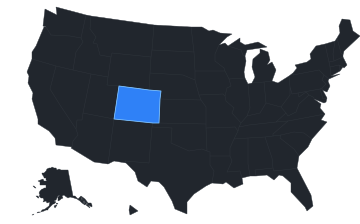
What SB 24-205 requires
Colorado has enacted SB 24-205 — Colorado AI Act (amended 2026 by SB 26-189). The most comprehensive US state AI law. As amended by SB 26-189 (2026) it takes effect January 1, 2027 and centers on transparency/disclosure for consequential automated decisions (the original algorithmic-discrimination duty of care was repealed). Attorney General rulemaking is underway; no final rules have been published yet. This page explains what the law requires in plain language, who is in scope, the penalty for non-compliance, and what your business needs to do before the January 1, 2027 deadline.
Who is in scope
The law covers any business in Colorado that uses algorithmic tools to screen job applications, score interviews, rank candidates, evaluate employee performance, or make promotion and termination decisions; businesses that use AI to interact with consumers, make consumer-facing decisions (credit, pricing, recommendations, content delivery), or generate AI content that is presented to the public; and any operator deploying AI systems that interact with consumers, influence decision-making, or could produce discriminatory outcomes in housing, credit, employment, or public accommodations. Company size does not determine whether you are in scope — a startup with ten employees using an off-the-shelf AI hiring tool has the same disclosure obligations as an enterprise running a custom-built model. What matters is whether the AI system makes or substantially informs a decision that affects a Colorado resident in a consequential way. Notably, the obligation extends to vendors: if your company deploys an AI tool built by a third party, you — as the deployer — are responsible for ensuring it meets Colorado's requirements, even if you did not build it.
Key compliance requirements
Colorado's employment AI rules create concrete pre-deployment and ongoing obligations. Before any AI tool enters the hiring or performance-management pipeline, employers must be able to document what data the system uses, how it reaches a decision, and what steps have been taken to detect and mitigate bias. Affected candidates and employees are entitled to notice that AI is involved — that notice must be provided before the AI evaluation takes place, not after an adverse decision has already been issued. Many employment AI statutes also require that a human reviewer be available to consider any appeal of an AI-assisted adverse action, preventing a loop where an algorithm's decision becomes final with no meaningful override path.
Colorado's consumer AI transparency requirements focus on two baseline obligations: disclosure and opt-out. Businesses must inform consumers when an AI system is involved in a consequential decision — meaning a decision that meaningfully affects a consumer's access to services, pricing, credit, or opportunities. The opt-out requirement gives consumers a mechanism to request human review or to decline AI-driven processing entirely. Meeting this standard is not just a notice-posting exercise: companies need to map every consumer-facing AI touchpoint, verify that their disclosure language is accurate and readable, and build a functioning human-review pathway that responds to opt-out requests within a defined window.
Colorado's law specifically targets AI systems designed to manipulate human behavior or produce discriminatory outcomes. A system is considered manipulative if it exploits psychological biases, creates false urgency, or targets vulnerable populations in ways that undermine informed consent. The anti-discrimination provisions extend existing civil-rights frameworks into AI: companies cannot deploy AI that produces disparate outcomes in protected categories even if no discriminatory intent existed. This requires testing AI outputs across demographic groups before deployment and building ongoing monitoring into the operational pipeline.
Penalties for non-compliance
The financial consequences of non-compliance under SB 24-205 are real and enforceable now. Colorado sets a maximum civil penalty of AG-enforced (Colorado Consumer Protection Act); up to ~$20,000 per violation. Penalties accumulate per violation — meaning a company that has deployed an AI tool to thousands of consumers without required disclosures faces compounding exposure, not a single capped fine. Employment AI violations often trigger parallel exposure: an employer who fails to provide required notice faces state penalties AND increased litigation risk under federal equal-employment law, because documented failure to audit for bias can be used as evidence of disparate-impact intent in private lawsuits.
What to do now
Build your AI inventory first. You cannot comply with Colorado's requirements if you do not know which systems are in scope. Map every AI or automated decision system your company uses that touches Colorado residents — including third-party vendor tools integrated into your product.
Audit hiring tools before the deadline. Commission or conduct a bias audit on any resume screener, interview scorer, or performance-management AI. Document the methodology, the demographic breakdown of outcomes, and the steps taken to mitigate any identified disparities.
Implement candidate and employee notice. Update job postings, onboarding materials, and performance-review workflows to include required disclosures. Verify that the notice is delivered before the AI evaluation occurs.
Draft accurate disclosure language. Work with legal counsel to produce disclosure statements that accurately describe what your AI does, what data it uses, and what the consumer can do if they want human review. Vague or boilerplate disclosures will not satisfy Colorado's requirements.
Build the opt-out pathway. Implement a functioning process for consumers to request human review or opt out of AI-assisted processing. Test it before the deadline — regulators will look for live, working mechanisms, not documented promises.
Assign a compliance owner. Designate someone — legal counsel, a privacy officer, or a dedicated AI governance lead — to track regulatory developments, own the audit documentation, and respond if an enforcement inquiry arrives. The compliance deadline is January 1, 2027. Don't wait until the deadline to start.
Colorado AI law in the broader regulatory landscape
Colorado's law does not exist in isolation. The trend across the United States is toward more regulation, not less: at least 20 states enacted or proposed AI-specific legislation in 2025 alone, and federal enforcement agencies — the FTC, EEOC, CFPB, and HHS — have all issued guidance making clear that existing laws apply to AI systems even where no AI-specific statute exists. For companies based in Colorado that serve European customers, the EU AI Act (effective August 2026) adds a parallel compliance track with penalties reaching €35 million or 7% of global annual revenue — making Colorado + EU compliance the most complex dual-jurisdiction stack currently in play.
Recent AI law developments in Colorado
Updated August 23, 2026Recent news coverage of AI regulation and policy in Colorado. Headlines are aggregated automatically; follow each link for the full story.

Coverage from forkast.news on AI legislation and regulation relevant to Colorado.

Coverage from Wiley Rein on AI legislation and regulation relevant to Colorado.

Coverage from JD Supra on AI legislation and regulation relevant to Colorado.

Coverage from Consumer Financial Services Law Monitor on AI legislation and regulation relevant to Colorado.

Coverage from Reuters on AI legislation and regulation relevant to Colorado.
AI bills moving through the Colorado legislature
Updated August 31, 2026AI-related bills currently tracked in the Colorado legislature, updated automatically from Open States and the state legislature's own official record. Follow each link for the official bill text, sponsors, and status history.
The act prohibits individuals lawfully permitted to provide psychotherapy services in the state (regulated professionals) from allowing an artificial intelligence system (AI system) to interact with clients in any form of therapeutic communication without synchronous, real-time interaction between the regulated prof…
Governor Signed
On and after January 1, 2027, when determining coverage for health-care services, the act requires entities that use an artificial intelligence system (AI system) for the purpose of conducting utilization review of health-care services, including health insurance companies (carriers), pharmacy benefit managers, priv…
Governor Signed
The act defines a 'conversational artificial intelligence service' as an artificial intelligence system that is accessible to the general public and that primarily simulates human conversation and interaction through adaptive textual, visual, or aural communications. Effective January 1, 2027, the act creates requir…
Governor Signed
In 2024, the general assembly enacted Senate Bill 24-205, which created consumer protections in interactions with artificial intelligence systems. The act repeals and reenacts those provisions with new requirements regarding the use of automated decision-making technology in consequential decisions. The act defines …
Governor Signed
The bill establishes that the use of artificial intelligence systems or required disclosure artificial intelligence systems (artificial intelligence systems) must comply with the "Colorado Consumer Protection Act". The attorney general may bring a claim against a developer or a deployer that uses an artificial intel…
House Third Reading Laid Over Daily - No Amendments
In 2024, the general assembly enacted Senate Bill 24-205, which created consumer protections in interactions with artificial intelligence systems (provisions).The provisions include a definition of "consequential decision", which definition determines the types of artificial intelligence systems that are considered …
Introduced In House - Assigned to Business Affairs & Labor
Senate Committee on Business, Labor, & Technology Postpone Indefinitely
The bill prohibits a developer that has trained a foundation artificial intelligence model (foundation model) from preventing a worker from, or retaliating against a worker for, disclosing or threatening to disclose information to the developer, the attorney general, or appropriate state or federal authorities if th…
House Second Reading Laid Over to 05/09/2025 - No Amendments
In current law there is a prohibition on schools contracting for facial recognition services that is set to repeal on July 1, 2025. The prohibition contains an exception for a contract executed prior to the date the prohibition became law or a renewal of that contract. The act removes the repeal and creates new exce…
Governor Signed
Wildfire Matters Review Committee. The bill requires the general assembly to appropriate $7,500,000 to the division of fire prevention and control (division) for state fiscal year 2024-25 and allows any unexpended portion of the appropriation to also be expended in state fiscal year 2025-26. The division is required…
Senate Committee on Transportation & Energy Postpone Indefinitely
Applicable laws
↗ Each law links to its primary government source. Full source list below.
Landmark AI laws in Colorado
Dedicated pages for Colorado's headline AI laws — status, penalty, effective date, and the official text.
Signed into law by

Colorado AI compliance by industry
AI compliance by company size
Jump to top-risk sectors for your company size
Quick resources for Colorado
Industry risk levels in Colorado
Do you also serve EU customers?
The EU AI Act applies to any company serving EU customers, even if you're based in Colorado. Penalties reach €35M or 7% of global revenue. Deadline: August 2, 2026.
Other states with active AI laws
Anchored to the primary government source (statute, bill text, or agency rule) and verified directly against it · Last verified Jul 11, 2026. See our methodology.
- ↗leg.colorado.govhttps://leg.colorado.gov/bills/sb24-205
- ↗fostergraham.comhttps://fostergraham.com/2025/12/colorados-artificial-intelligence-act-what-b…