 Study Phase
AI Laws in Ohio (OH)
Voluntary AI principles adopted. Mandatory framework expected 2027.
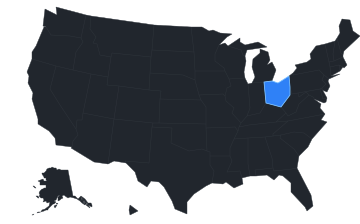
What AI Task Force Recommendations requires
Ohio has enacted AI Task Force Recommendations. Voluntary AI principles adopted. Mandatory framework expected 2027. This page explains what the law requires in plain language, who is in scope, the penalty for non-compliance, and what your business needs to do.
Who is in scope
The law covers businesses that use AI to interact with consumers, make consumer-facing decisions (credit, pricing, recommendations, content delivery), or generate AI content that is presented to the public. Company size does not determine whether you are in scope — a startup with ten employees using an off-the-shelf AI hiring tool has the same disclosure obligations as an enterprise running a custom-built model. What matters is whether the AI system makes or substantially informs a decision that affects a Ohio resident in a consequential way. Notably, the obligation extends to vendors: if your company deploys an AI tool built by a third party, you — as the deployer — are responsible for ensuring it meets Ohio's requirements, even if you did not build it.
Key compliance requirements
Ohio's consumer AI transparency requirements focus on two baseline obligations: disclosure and opt-out. Businesses must inform consumers when an AI system is involved in a consequential decision — meaning a decision that meaningfully affects a consumer's access to services, pricing, credit, or opportunities. The opt-out requirement gives consumers a mechanism to request human review or to decline AI-driven processing entirely. Meeting this standard is not just a notice-posting exercise: companies need to map every consumer-facing AI touchpoint, verify that their disclosure language is accurate and readable, and build a functioning human-review pathway that responds to opt-out requests within a defined window.
Penalties for non-compliance
Ohio's AI law gives the state attorney general authority to investigate violations and seek civil relief. While statutory penalty amounts are still being finalized by implementing regulations, enforcement precedent from early AI cases in other states suggests regulators will prioritize companies with the widest reach and the most significant consumer impact. Consumer AI violations in Ohio may also attract federal coordination: the FTC's Operation AI Comply sweep (September 2024) demonstrated that state and federal enforcers share intelligence on companies with widespread AI disclosure failures.
What to do now
Build your AI inventory first. You cannot comply with Ohio's requirements if you do not know which systems are in scope. Map every AI or automated decision system your company uses that touches Ohio residents — including third-party vendor tools integrated into your product.
Draft accurate disclosure language. Work with legal counsel to produce disclosure statements that accurately describe what your AI does, what data it uses, and what the consumer can do if they want human review. Vague or boilerplate disclosures will not satisfy Ohio's requirements.
Build the opt-out pathway. Implement a functioning process for consumers to request human review or opt out of AI-assisted processing. Test it before the deadline — regulators will look for live, working mechanisms, not documented promises.
Assign a compliance owner. Designate someone — legal counsel, a privacy officer, or a dedicated AI governance lead — to track regulatory developments, own the audit documentation, and respond if an enforcement inquiry arrives. Ohio's implementing regulations are expected to set precise compliance deadlines. Don't wait until the deadline to start.
Ohio AI law in the broader regulatory landscape
Ohio's law does not exist in isolation. The trend across the United States is toward more regulation, not less: at least 20 states enacted or proposed AI-specific legislation in 2025 alone, and federal enforcement agencies — the FTC, EEOC, CFPB, and HHS — have all issued guidance making clear that existing laws apply to AI systems even where no AI-specific statute exists. Companies doing business across state lines must track each state's requirements independently — there is no federal preemption that would allow a company to satisfy Ohio's law and automatically comply with requirements in Illinois, Colorado, or New York.
Recent AI law developments in Ohio
Updated August 26, 2026Recent news coverage of AI regulation and policy in Ohio. Headlines are aggregated automatically; follow each link for the full story.

Coverage from Ohio House of Representatives (.gov) on AI legislation and regulation relevant to Ohio.

Coverage from Ad-hoc-news.de on AI legislation and regulation relevant to Ohio.

Coverage from NBC4 WCMH-TV on AI legislation and regulation relevant to Ohio.
AI bills moving through the Ohio legislature
Updated August 29, 2026AI-related bills currently tracked in the Ohio legislature, updated automatically from Open States and the state legislature's own official record. Follow each link for the official bill text, sponsors, and status history.
To amend sections 1345.51, 2907.321, 2907.322, 2907.323, and 2913.49 and to enact section 1349.10 of the Revised Code to require AI-generated products have a watermark, to prohibit simulated child pornography, and to prohibit identity fraud using a replica of a person.
Referred to committee
To enact section 4113.90 of the Revised Code regarding the use of automated employment decision tools.
Referred to committee
To enact sections 1349.12, 1349.13, 1349.14, 1349.15, and 1349.16 of the Revised Code to require AI-generated products have a watermark and to require disclosure when AI-systems are acting as humans.
Referred to committee
Honoring the Ridgewood High School AI for Youth team on winning the 2026 Ohio Presidential AI Challenge.
Adopted
To urge the Congress of the United States to reject any moratorium on state laws regulating artificial intelligence.
Referred to committee
To create the Artificial Intelligence Study Commission to study and make recommendations regarding the use of artificial intelligence in state and local government.
Referred to committee
To urge the Congress of the United States to reject any moratorium on state laws regulating artificial intelligence.
Introduced and Referred to Committee
To enact sections 3755.01, 3755.02, 3755.03, 3755.04, 3755.041, 3755.05, 3755.06, 3755.07, 3755.08, 3755.09, 3755.091, 3755.10, 3755.11, and 3755.12 of the Revised Code to create an independent verification organization license for verifying artificial intelligence risk mitigation.
Referred to committee
To amend section 3902.50 and to enact section 3902.80 of the Revised Code to regulate the use of artificial intelligence by health insurers.
Referred to committee
To amend sections 2741.01, 2741.02, 2741.05, 2741.06, 2741.09, and 2905.11 and to enact sections 2742.01, 2742.02, 2742.03, and 2742.04 of the Revised Code to make changes to the law relating to the unauthorized use of an individual's persona and to prohibit certain unauthorized deepfake recordings.
Referred to committee
Applicable laws
↗ Each law links to its primary government source. Full source list below.
Ohio AI compliance by industry
AI compliance by company size
Jump to top-risk sectors for your company size
Quick resources for Ohio
Industry risk levels in Ohio
Do you also serve EU customers?
The EU AI Act applies to any company serving EU customers, even if you're based in Ohio. Penalties reach €35M or 7% of global revenue. Deadline: August 2, 2026.
Other states with active AI laws
Anchored to the primary government source (statute, bill text, or agency rule) and verified directly against it · Last verified Aug 15, 2026. See our methodology.
- ↗das.ohio.govhttps://das.ohio.gov/technology-and-strategy/policies/it-17