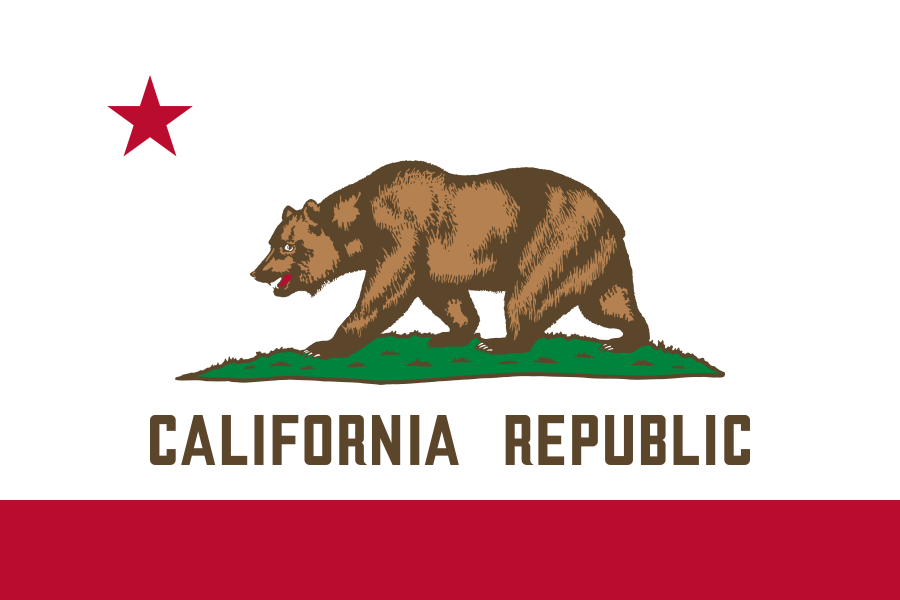
 Enacted
AI Laws in California (CA)
Generative-AI providers with over 1,000,000 monthly users must offer a free AI-detection tool and embed a latent provenance disclosure in AI-generated image, video and audio content, plus an optional visible manifest disclosure. Operative August 2, 2026 (delayed from January 1, 2026 by AB 853).
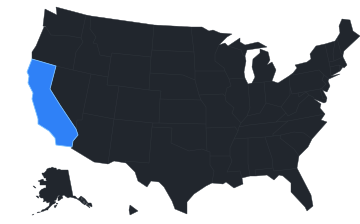
What SB 942 requires
California has enacted SB 942 — AI Transparency Act. Generative-AI providers with over 1,000,000 monthly users must offer a free AI-detection tool and embed a latent provenance disclosure in AI-generated image, video and audio content, plus an optional visible manifest disclosure. Operative August 2, 2026 (delayed from January 1, 2026 by AB 853). This page explains what the law requires in plain language, who is in scope, the penalty for non-compliance, and what your business needs to do before the August 2, 2026 deadline.
Who is in scope
The law covers businesses that use AI to interact with consumers, make consumer-facing decisions (credit, pricing, recommendations, content delivery), or generate AI content that is presented to the public. Company size does not determine whether you are in scope — a startup with ten employees using an off-the-shelf AI hiring tool has the same disclosure obligations as an enterprise running a custom-built model. What matters is whether the AI system makes or substantially informs a decision that affects a California resident in a consequential way. Notably, the obligation extends to vendors: if your company deploys an AI tool built by a third party, you — as the deployer — are responsible for ensuring it meets California's requirements, even if you did not build it.
Key compliance requirements
California's consumer AI transparency requirements focus on two baseline obligations: disclosure and opt-out. Businesses must inform consumers when an AI system is involved in a consequential decision — meaning a decision that meaningfully affects a consumer's access to services, pricing, credit, or opportunities. The opt-out requirement gives consumers a mechanism to request human review or to decline AI-driven processing entirely. Meeting this standard is not just a notice-posting exercise: companies need to map every consumer-facing AI touchpoint, verify that their disclosure language is accurate and readable, and build a functioning human-review pathway that responds to opt-out requests within a defined window.
Penalties for non-compliance
The financial consequences of non-compliance under SB 942 are real and enforceable now. California sets a maximum civil penalty of $5,000 per violation; each day is a discrete violation. Penalties accumulate per violation — meaning a company that has deployed an AI tool to thousands of consumers without required disclosures faces compounding exposure, not a single capped fine. Consumer AI violations in California may also attract federal coordination: the FTC's Operation AI Comply sweep (September 2024) demonstrated that state and federal enforcers share intelligence on companies with widespread AI disclosure failures.
What to do now
Build your AI inventory first. You cannot comply with California's requirements if you do not know which systems are in scope. Map every AI or automated decision system your company uses that touches California residents — including third-party vendor tools integrated into your product.
Draft accurate disclosure language. Work with legal counsel to produce disclosure statements that accurately describe what your AI does, what data it uses, and what the consumer can do if they want human review. Vague or boilerplate disclosures will not satisfy California's requirements.
Build the opt-out pathway. Implement a functioning process for consumers to request human review or opt out of AI-assisted processing. Test it before the deadline — regulators will look for live, working mechanisms, not documented promises.
Assign a compliance owner. Designate someone — legal counsel, a privacy officer, or a dedicated AI governance lead — to track regulatory developments, own the audit documentation, and respond if an enforcement inquiry arrives. The compliance deadline is August 2, 2026. Don't wait until the deadline to start.
California AI law in the broader regulatory landscape
California's law does not exist in isolation. The trend across the United States is toward more regulation, not less: at least 20 states enacted or proposed AI-specific legislation in 2025 alone, and federal enforcement agencies — the FTC, EEOC, CFPB, and HHS — have all issued guidance making clear that existing laws apply to AI systems even where no AI-specific statute exists. For companies based in California that serve European customers, the EU AI Act (effective August 2026) adds a parallel compliance track with penalties reaching €35 million or 7% of global annual revenue — making California + EU compliance the most complex dual-jurisdiction stack currently in play.
Recent AI law developments in California
Updated August 23, 2026Recent news coverage of AI regulation and policy in California. Headlines are aggregated automatically; follow each link for the full story.

Coverage from TechCrunch on AI legislation and regulation relevant to California.

Coverage from Politico on AI legislation and regulation relevant to California.

Coverage from KQED on AI legislation and regulation relevant to California.

Coverage from SFGATE on AI legislation and regulation relevant to California.

Coverage from FOX40 on AI legislation and regulation relevant to California.
AI bills moving through the California legislature
Updated August 31, 2026AI-related bills currently tracked in the California legislature, updated automatically from Open States and the state legislature's own official record. Follow each link for the official bill text, sponsors, and status history.
Existing law charges the Labor Commissioner with enforcement of various labor laws, including investigation of employee complaints. This bill would declare it is the policy of the state that a worker providing direct patient care be free to use their professional judgment to make assessments and decisions within the…
Read second time. Ordered to third reading.
Existing law requires a health facility, clinic, physician's office, or office of a group practice that uses generative artificial intelligence to generate written or verbal patient communications pertaining to patient clinical information, as defined, to ensure that those communications include both (1) a disclaime…
Enrolled and presented to the Governor at 6 p.m.
Existing law establishes various healing arts boards within the Department of Consumer Affairs that license and regulate various healing arts licensees. Existing laws, including the Licensed Marriage and Family Therapist Act, the Educational Psychologist Practice Act, the Clinical Social Worker Practice Act, and the…
Read third time. Passed. Ordered to the Senate.
Existing law establishes the Department of Technology within the Government Operations Agency. Existing law requires the department to conduct, in coordination with other interagency bodies as it deems appropriate, a comprehensive inventory of all high-risk automated decision systems that have been proposed for use,…
Senate amendments concurred in. To Engrossing and Enrolling.
Existing law requires the Department of Technology to conduct, in coordination with other interagency bodies as it deems appropriate, a comprehensive inventory of all high-risk automated decision systems (ADS) that have been proposed for use, development, or procurement by, or are being used, developed, or procured …
Read third time. Passed. Ordered to the Senate.
The California Fair Employment and Housing Act establishes the Civil Rights Department within the Business, Consumer Services, and Housing Agency and requires the department to, among other things, bring civil actions to enforce the act. Existing law requires, on or before September 1, 2024, the Department of Techno…
Read second time. Ordered to third reading.
The California Constitution provides that people have the right of access to information concerning the conduct of the people's business. Various provisions of existing law, including the California Public Records Act, the Legislative Open Records Act, the Bagley-Keene Open Meeting Act, and the Ralph M. Brown Act, p…
Enrolled and presented to the Governor at 11 a.m.
Existing law establishes the California Community Colleges, administered by the Board of Governors of the California Community Colleges, as one of the segments of public postsecondary education in the state. Existing law requires the board to appoint a chief executive officer, known as the Chancellor of the Californ…
Enrolled and presented to the Governor at 3:30 p.m.
(1) The Confidentiality of Medical Information Act (CMIA) prohibits a provider of health care, a health care service plan, a contractor, or a corporation and its subsidiaries and affiliates from intentionally sharing, selling, using for marketing, or otherwise using any medical information, as defined, for any purpo…
Senate amendments concurred in. To Engrossing and Enrolling. (Ayes 66. Noes 10.).
Existing law establishes the California Community Colleges, under the administration of the Board of Governors of the California Community Colleges, the California State University, under the administration of the Trustees of the California State University, and the University of California, under the administration…
Senate amendments concurred in. To Engrossing and Enrolling. (Ayes 79. Noes 0.).
Executive Order No. N-12-23 requires specified state agencies, in collaboration with other state agencies and their workforce, to draft a report to the Governor examining the most significant, potentially beneficial use cases for deployment of generative artificial intelligence (GenAI) tools by the state. The execut…
Senate amendments concurred in. To Engrossing and Enrolling. (Ayes 74. Noes 2.).
Existing law, the State Bar Act, provides for the licensure and regulation of attorneys by the State Bar of California (State Bar) , a public corporation governed by a board of trustees. Existing law authorizes the State Bar to establish an examining committee, also known as the Committee of Bar Examiners, with powe…
Chaptered by Secretary of State - Chapter 116, Statutes of 2026.
Existing law, the California Emergency Services Act, establishes the California Cybersecurity Integration Center within the Office of Emergency Services to serve as the central organizing hub of state government's cybersecurity activities and to coordinate information sharing with various entities. Existing law also…
August 13 hearing: Held in committee and under submission.
Existing law establishes the Employment Development Department (EDD) , which is administered by the Director of Employment Development. Under existing law, the Director of Employment Development is vested with specified duties, purposes, responsibilities, and jurisdiction related to job creation activity functions, …
In committee: Held under submission.
Existing federal law, through copyright, provides authors of original works of authorship, as defined, with certain rights and protections. Existing federal law generally gives the owner of the copyright the right to reproduce the work in copies or phonorecords and the right to distribute copies or phonorecords of t…
In committee: Held under submission.
This measure would encourage the President of the University of California, the Chancellor of the California State University, and the Chancellor of the California Community Colleges to create a workgroup of faculty, staff, and administrators to (1) review the use of artificial intelligence in higher education, (2) …
August 13 hearing: Held in committee and under submission.
Existing law requires the Office of Emergency Services to, as appropriate, perform a risk analysis of potential threats posed by the use of generative artificial intelligence to California's critical infrastructure, including those that could lead to mass casualty events. Existing law requires that risk analysis to …
August 13 hearing: Held in committee and under submission.
Existing law establishes the Office of Small Business Advocate within the Governor's Office of Business and Economic Development and prescribes the duties and functions of the Small Business Advocate. Existing law requires the advocate to, among other duties, serve as the principal advocate in the state on behalf of…
In committee: Held under submission.
Existing law establishes the Division of Labor Standards Enforcement within the Department of Industrial Relations to administer and enforce various laws relating to employment and working conditions. This bill would require an employer to provide a written notice to a worker that a workplace AI tool, as defined, wa…
In committee: Held under submission.
Existing law establishes the Division of Labor Standards Enforcement within the Department of Industrial Relations. Existing law authorizes the division, which is headed by the Labor Commissioner, to enforce the Labor Code and all labor laws of the state, the enforcement of which is not specifically vested in any ot…
In committee: Held under submission.
Applicable laws
↗ Each law links to its primary government source. Full source list below.
Landmark AI laws in California
Dedicated pages for California's headline AI laws — status, penalty, effective date, and the official text.
Signed into law by
California AI compliance by industry
AI compliance by company size
Jump to top-risk sectors for your company size
Quick resources for California
Industry risk levels in California
Do you also serve EU customers?
The EU AI Act applies to any company serving EU customers, even if you're based in California. Penalties reach €35M or 7% of global revenue. Deadline: August 2, 2026.
Other states with active AI laws
Anchored to the primary government source (statute, bill text, or agency rule) and verified directly against it · Last verified Jul 10, 2026. See our methodology.
- ↗leginfo.legislature.ca.govhttps://leginfo.legislature.ca.gov/faces/billNavClient.xhtml?bill_id=20232024…
- ↗leginfo.legislature.ca.govhttps://leginfo.legislature.ca.gov/faces/billTextClient.xhtml?bill_id=2025202…