🔴Illinois HB 3773IN EFFECTUp to ~$70K/violation|🔴Texas TRAIGA (HB 149)IN EFFECTAG-enforced|🔴Utah AI Policy ActIN EFFECT$2,500/violation|⚠️Colorado AI Act (SB 205)Jan 1, 2027AG-enforced|⚠️California SB 942Aug 2, 2026$5K/day|⚠️EU AI Act Art. 50Aug 2, 2026€35M or 7% revenue|⚠️New York RAISE ActJan 1, 2027AG civil penalties|🔴Illinois HB 3773IN EFFECTUp to ~$70K/violation|🔴Texas TRAIGA (HB 149)IN EFFECTAG-enforced|🔴Utah AI Policy ActIN EFFECT$2,500/violation|⚠️Colorado AI Act (SB 205)Jan 1, 2027AG-enforced|⚠️California SB 942Aug 2, 2026$5K/day|⚠️EU AI Act Art. 50Aug 2, 2026€35M or 7% revenue|⚠️New York RAISE ActJan 1, 2027AG civil penalties|
Last verified · Jul 11, 2026Sourced from official primary sourceslegis.state.pa.us.
ProposedDeadline: TBD
Flag of Pennsylvania

AI Laws in Pennsylvania (PA)

Would require clear and conspicuous disclosure of artificial-intelligence-generated content. Passed the PA House in 2024; not yet enacted (reintroduced as HB 95 in the 2025-2026 session).
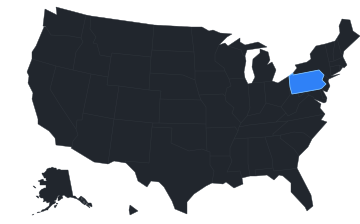
Map showing the location of Pennsylvania in the United States
Pennsylvania within the United States

What HB 1598 (2023-24) requires

Pennsylvania has enacted HB 1598 (2023-24) — AI-generated content disclosure (reintroduced as HB 95, 2025-26). Would require clear and conspicuous disclosure of artificial-intelligence-generated content. Passed the PA House in 2024; not yet enacted (reintroduced as HB 95 in the 2025-2026 session). This page explains what the law requires in plain language, who is in scope, the penalty for non-compliance, and what your business needs to do.

Who is in scope

The law covers businesses that use AI to interact with consumers, make consumer-facing decisions (credit, pricing, recommendations, content delivery), or generate AI content that is presented to the public. Company size does not determine whether you are in scope — a startup with ten employees using an off-the-shelf AI hiring tool has the same disclosure obligations as an enterprise running a custom-built model. What matters is whether the AI system makes or substantially informs a decision that affects a Pennsylvania resident in a consequential way. Notably, the obligation extends to vendors: if your company deploys an AI tool built by a third party, you — as the deployer — are responsible for ensuring it meets Pennsylvania's requirements, even if you did not build it.

Key compliance requirements

Pennsylvania's consumer AI transparency requirements focus on two baseline obligations: disclosure and opt-out. Businesses must inform consumers when an AI system is involved in a consequential decision — meaning a decision that meaningfully affects a consumer's access to services, pricing, credit, or opportunities. The opt-out requirement gives consumers a mechanism to request human review or to decline AI-driven processing entirely. Meeting this standard is not just a notice-posting exercise: companies need to map every consumer-facing AI touchpoint, verify that their disclosure language is accurate and readable, and build a functioning human-review pathway that responds to opt-out requests within a defined window.

Penalties for non-compliance

Pennsylvania's AI law gives the state attorney general authority to investigate violations and seek civil relief. While statutory penalty amounts are still being finalized by implementing regulations, enforcement precedent from early AI cases in other states suggests regulators will prioritize companies with the widest reach and the most significant consumer impact. Consumer AI violations in Pennsylvania may also attract federal coordination: the FTC's Operation AI Comply sweep (September 2024) demonstrated that state and federal enforcers share intelligence on companies with widespread AI disclosure failures.

What to do now

Build your AI inventory first. You cannot comply with Pennsylvania's requirements if you do not know which systems are in scope. Map every AI or automated decision system your company uses that touches Pennsylvania residents — including third-party vendor tools integrated into your product.

Draft accurate disclosure language. Work with legal counsel to produce disclosure statements that accurately describe what your AI does, what data it uses, and what the consumer can do if they want human review. Vague or boilerplate disclosures will not satisfy Pennsylvania's requirements.

Build the opt-out pathway. Implement a functioning process for consumers to request human review or opt out of AI-assisted processing. Test it before the deadline — regulators will look for live, working mechanisms, not documented promises.

Assign a compliance owner. Designate someone — legal counsel, a privacy officer, or a dedicated AI governance lead — to track regulatory developments, own the audit documentation, and respond if an enforcement inquiry arrives. Pennsylvania's implementing regulations are expected to set precise compliance deadlines. Don't wait until the deadline to start.

Pennsylvania AI law in the broader regulatory landscape

Pennsylvania's law does not exist in isolation. The trend across the United States is toward more regulation, not less: at least 20 states enacted or proposed AI-specific legislation in 2025 alone, and federal enforcement agencies — the FTC, EEOC, CFPB, and HHS — have all issued guidance making clear that existing laws apply to AI systems even where no AI-specific statute exists. Companies doing business across state lines must track each state's requirements independently — there is no federal preemption that would allow a company to satisfy Pennsylvania's law and automatically comply with requirements in Illinois, Colorado, or New York.

✓ Free · No email · 2 minutes
Does your Pennsylvania business comply with AI laws?
Answer 4 quick questions → get your personalized risk score + action list.
Check My Risk — Free →
● Live

Recent AI law developments in Pennsylvania

Updated July 12, 2026

Recent news coverage of AI regulation and policy in Pennsylvania. Headlines are aggregated automatically; follow each link for the full story.

AI Law NewsFlag of Pennsylvania
Route Fifty
June 24, 2026
Pennsylvania House committee splits along party lines over regulation proposal for AI chatbots

Coverage from Route Fifty on AI legislation and regulation relevant to Pennsylvania.

Route Fifty·
AI Law NewsFlag of Pennsylvania
Transparency Coalition
June 22, 2026
These AI bills are advancing in Pennsylvania as lawmakers eye June 30 summer recess

Coverage from Transparency Coalition on AI legislation and regulation relevant to Pennsylvania.

Transparency Coalition·
AI Law NewsFlag of Pennsylvania
WFMJ
June 18, 2026
Pennsylvania bill would mandate disclosure of AI use in ads

Coverage from WFMJ on AI legislation and regulation relevant to Pennsylvania.

WFMJ·
AI Law NewsFlag of Pennsylvania
The Center Square
June 18, 2026
Lawmakers want to call out AI in advertising but can't decide how

Coverage from The Center Square on AI legislation and regulation relevant to Pennsylvania.

The Center Square·
AI Law NewsFlag of Pennsylvania
Duane Morris Government Strategies
June 8, 2026
Pennsylvania AI Data Center Legislation in 2026: What Companies Need to Know

Coverage from Duane Morris Government Strategies on AI legislation and regulation relevant to Pennsylvania.

Duane Morris Government Strategies·
Live · Legislature

AI bills moving through the Pennsylvania legislature

Updated July 11, 2026

AI-related bills currently tracked in the Pennsylvania legislature, updated automatically from Open States and the state legislature's own official record. Follow each link for the official bill text, sponsors, and status history.

HB 2006An Act providing for safety regarding artificial intelligence in companionship applications; and imposing a penalty.

Re-committed to Appropriations

Open States·
HB 2678An Act amending Title 63 (Professions and Occupations (State Licensed)) of the Pennsylvania Consolidated Statutes, in powers and duties, further providing for definitions and providing for artificial intelligence.

Referred to Professional Licensure

Open States·
HB 1925An Act amending Titles 35 (Health and Safety), 40 (Insurance) and 67 (Public Welfare) of the Pennsylvania Consolidated Statutes, providing for artificial intelligence in facilities, for artificial intelligence use by insurers and for artificial intelligence use by MA or CHIP managed care plans; imposing duties on the Department of Health, the Insurance Department and the Department of Human Services; and imposing penalties.

Removed from table

Open States·
HB 2669An Act providing for employer disclosure when employee layoffs occur due to an employer's use of artificial intelligence or other technological change; and imposing civil penalties.

Referred to Labor & Industry

Open States·
HR 425A Resolution urging the United States Congress to suspend any and all efforts to pass Federal legislation that would impose a moratorium on state-level artificial intelligence regulation; recognizing the potential benefits along with the risks of misuse and systemic harm of artificial intelligence; acknowledging the importance of state regulation of such technologies; and reaffirming the Pennsylvania General Assembly's sovereign authority to legislate for the protection of Pennsylvanians.

Laid on the table (Pursuant to House Rule 71)

Open States·
HB 2666An Act providing for limitations on the use of user data in the creation of artificial intelligence simulations and for private right of action; and imposing penalties.

Referred to Communications & Technology

Open States·
HB 2637An Act providing for a temporary prohibition on artificial intelligence chatbots in children's toys; and imposing penalties.

Referred to Communications & Technology

Open States·
HB 2314An Act providing for a public education campaign focused on educating the public about artificial intelligence and improving AI consumer literacy.

Referred to Communications & Technology

Open States·
SB 1349An Act providing for transparency in use of generative artificial intelligence; requiring disclosure of synthetic content; providing for establishment of content verification tools; imposing duties on the Bureau of Consumer Protection in the Office of Attorney General; and imposing penalties.

Referred to Communications & Technology

Open States·
HB 2534An Act providing for artificial intelligence transparency, for duties of covered providers of generative artificial intelligence systems and for large online platforms and generative artificial intelligence system hosting platforms; and imposing a penalty.

Referred to Communications & Technology

Open States·
SB 1332An Act providing for notice of use of artificial intelligence or generative artificial intelligence in political advertisements.

Referred to State Government

Open States·
HB 2175An Act amending Title 12 (Commerce and Trade) of the Pennsylvania Consolidated Statutes, providing for consumer protection and for artificial intelligence and chatbots; imposing duties on the Bureau of Consumer Protection in the Office of Attorney General; and imposing penalties.

Re-referred to Consumer Protection, Technology & Utilities

Open States·
SB 1090An Act providing for disclosures and safeguards relating to the use of artificial intelligence; and imposing duties on the Attorney General.

Referred to Communications & Technology

Open States·
HB 2288An Act amending the act of December 17, 1968 (P.L.1224, No.387), known as the Unfair Trade Practices and Consumer Protection Law, providing for artificial intelligence training disclosure.

Referred to Communications & Technology

Open States·
SB 939Establishing the Office of Transformation and Opportunity and the Artificial Intelligence, Data Center and Emerging Technology Regulatory Sandbox Program; and providing for powers and duties of office and for permits for high impact data centers that have their own power.

Amended in Senate Committee on Communications & Technology

Open States·
SB 293An Act providing for a report on artificial intelligence in the workforce; and imposing duties on the Department of Labor and Industry and Department of Community and Economic Development.

Laid on the table (Pursuant to Senate Rule 9)

Open States·
SB 1113An Act amending Titles 35 (Health and Safety) and 40 (Insurance) of the Pennsylvania Consolidated Statutes, providing for artificial intelligence in facilities, for artificial intelligence use by insurers and for artificial intelligence use by MA or CHIP managed care plans; imposing duties on the Department of Health, the Insurance Department and the Department of Human Services; and imposing penalties.

Referred to Institutional Sustainability & Innovation

Open States·
HB 2100An Act providing for the use of mental health chatbots and artificial intelligence by mental health therapists; imposing duties on the Bureau of Professional and Occupational Affairs; and imposing a penalty.

Referred to Professional Licensure

Open States·
HB 1993An Act providing for the use of artificial intelligence in mental health therapy and for enforcement.

Referred to Professional Licensure

Open States·
HR 331A Resolution recognizing the exclusive constitutional authority of the Pennsylvania Supreme Court to regulate the practice of law in this Commonwealth and urging the Court to adopt safeguards governing the use of artificial intelligence by attorneys and judges.

Referred to Judiciary

Open States·
HB 1857An Act requiring business entities to disclose the use of artificial intelligence in certain consumer interactions; establishing the right of consumers to human review in high-impact decisions; and providing for enforcement by Attorney General.

Referred to Communications & Technology

Open States·
HB 1779An Act amending Title 12 (Commerce and Trade) of the Pennsylvania Consolidated Statutes, in preliminary provisions, providing for algorithmic pricing transparency and fairness; and imposing duties on the Office of Attorney General and Bureau of Consumer Protection.

Referred to Consumer Protection, Technology & Utilities

Open States·
HB 1625An Act establishing the Keystone Artificial Intelligence Authority within the Department of Community and Economic Development; providing for the duties of authority and its governing board; providing for duties of other entities; establishing the Artificial Intelligence Permitting System Pilot Program within the Department of Environmental Protection; establishing the Keystone Artificial Intelligence Development Fund; and providing for sovereign immunity.

Referred to Communications & Technology

Open States·
HR 81A Resolution urging the Congress of the United States to amend 17 U.S.C. §§ 102 and 107 to protect creative workers against displacement by artificial intelligence technology.

Laid on the table (Pursuant to House Rule 71)

Open States·
HB 1533An Act amending Title 18 (Crimes and Offenses) of the Pennsylvania Consolidated Statutes, in culpability, providing for liability for deployment of artificial intelligence system.

Referred to Judiciary

Open States·
HB 596An Act providing for a requirement for commercial establishments to disclose the use and collection of biometric identifier information and providing for a private cause of action.

Referred to Commerce

Open States·
HB 594An Act amending the act of October 27, 1955 (P.L.744, No.222), known as the Pennsylvania Human Relations Act, further providing for definitions; providing for use of automated employment decision tool; and further providing for civil penalties.

Referred to Labor & Industry

Open States·
HB 317An Act amending Title 18 (Crimes and Offenses) of the Pennsylvania Consolidated Statutes, in computer offenses, providing for artificial intelligence; and imposing a penalty.

Referred to Communications & Technology

Open States·
HB 2658An Act amending the act of March 10, 1949 (P.L.30, No.14), known as the Public School Code of 1949, in preliminary provisions, prohibiting biometric identifying technology.

Referred to Education

Open States·

Applicable laws

HB 1598 (2023-24) — AI-generated content disclosure (reintroduced as HB 95, 2025-26)TBD

↗ Each law links to its primary government source. Full source list below.

Pennsylvania AI compliance by industry

Healthcare
Finance & Banking
HR & Recruiting
Tech & SaaS
Marketing & Advertising
Insurance
Education
Legal Services
Real Estate
Retail & E-Commerce
Manufacturing
Transportation
Media & Entertainment
Nonprofit
Government Contractor

AI compliance by company size

Jump to top-risk sectors for your company size

Startups (1-10)
🏥 Healthcare
Small (11-50)
🏦 Finance
Mid-Market (51-500)
👥 HR & Recruiting
Enterprise (500+)
💻 Tech & SaaS

Quick resources for Pennsylvania

✅ Compliance checklist
💰 Fines & penalties
📋 Requirements
📖 Compliance guide
⏰ Deadlines

Industry risk levels in Pennsylvania

Risk by sector
🏥 HealthcareVery High
🏦 Finance & BankingVery High
💻 Tech & SaaSHigh
🛒 Retail & E-CommerceMedium-High
👔 HR & RecruitingVery High
⚖️ Legal ServicesHigh
📢 Marketing & AdvertisingMedium
🎓 EducationMedium-High
Risk levels based on Pennsylvania AI law requirements and industry-specific regulations

Do you also serve EU customers?

The EU AI Act applies to any company serving EU customers, even if you're based in Pennsylvania. Penalties reach €35M or 7% of global revenue. Deadline: August 2, 2026.

Check EU compliance →·GermanyFranceIreland

Other states with active AI laws

California
$5,000 per violation; each day is a discrete violation
Colorado
AG-enforced (Colorado Consumer Protection Act); up to ~$20,000 per violation
Illinois
IDHR/IHRC make-whole relief + tiered civil penalties up to ~$16,000–$70,000 per act per aggrieved party
Indiana
N/A (state-government governance)
Maine
Enforced as a violation of the Maine Unfair Trade Practices Act
Minnesota
Up to $7,500 per violation
Check your state's risk →

Related resources

Free AssessmentHealthcare AI LawsHR & Hiring AI LawsEU AI Act
Editorial standards

Anchored to the primary government source (statute, bill text, or agency rule) and verified directly against it · Last verified Jul 11, 2026. See our methodology.

Primary sources · Pennsylvania