
🔴Illinois HB 3773IN EFFECTUp to ~$70K/violation|🔴Texas TRAIGA (HB 149)IN EFFECTAG-enforced|🔴Utah AI Policy ActIN EFFECT$2,500/violation|⚠️Colorado AI Act (SB 205)Jan 1, 2027AG-enforced|⚠️California SB 942Aug 2, 2026$5K/day|⚠️EU AI Act Art. 50Aug 2, 2026€35M or 7% revenue|⚠️New York RAISE ActJan 1, 2027AG civil penalties|
United States · New JerseyFlag of New JerseyProposed

AI Laws in New Jersey (NJ)

Requires impact assessments for automated decision systems affecting employment and housing.
Deadline: 2027
Last checked yesterday🕐 25 Aug 2026, 00:47 UTC20 of 81 tracked New Jersey records re-checked · last change Jul 12, 2026njleg.state.nj.us
81
Records tracked
83
AI bills in the legislature
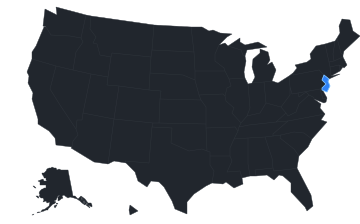
Map showing the location of New Jersey in the United States
New Jersey within the United States

What A4115 requires

New Jersey has enacted A4115 — Automated Decision Systems. Requires impact assessments for automated decision systems affecting employment and housing. This page explains what the law requires in plain language, who is in scope, the penalty for non-compliance, and what your business needs to do before the 2027 deadline.

Who is in scope

The law covers any business in New Jersey that uses algorithmic tools to screen job applications, score interviews, rank candidates, evaluate employee performance, or make promotion and termination decisions, and developers who build AI systems classified as high-risk — typically systems that influence consequential decisions in credit, employment, healthcare, education, housing, or government services — and the companies that deploy them. Company size does not determine whether you are in scope — a startup with ten employees using an off-the-shelf AI hiring tool has the same disclosure obligations as an enterprise running a custom-built model. What matters is whether the AI system makes or substantially informs a decision that affects a New Jersey resident in a consequential way. Notably, the obligation extends to vendors: if your company deploys an AI tool built by a third party, you — as the deployer — are responsible for ensuring it meets New Jersey's requirements, even if you did not build it.

Key compliance requirements

New Jersey's employment AI rules create concrete pre-deployment and ongoing obligations. Before any AI tool enters the hiring or performance-management pipeline, employers must be able to document what data the system uses, how it reaches a decision, and what steps have been taken to detect and mitigate bias. Affected candidates and employees are entitled to notice that AI is involved — that notice must be provided before the AI evaluation takes place, not after an adverse decision has already been issued. Many employment AI statutes also require that a human reviewer be available to consider any appeal of an AI-assisted adverse action, preventing a loop where an algorithm's decision becomes final with no meaningful override path.

New Jersey's risk-assessment framework requires that developers and deployers of high-impact AI systems conduct formal impact assessments before deployment and re-evaluate them when the system changes materially. An impact assessment must document the intended purpose of the system, the data it uses, the populations it affects, known accuracy limitations, and what bias-testing was performed. Deployers must also publish a summary of the assessment that is accessible to consumers and regulators — internal documentation alone is insufficient. Critically, the assessment is not a one-time exercise: New Jersey's law contemplates ongoing monitoring, with a duty to update documentation when performance data or demographic outputs shift.

Penalties for non-compliance

New Jersey's AI law gives the state attorney general authority to investigate violations and seek civil relief. While statutory penalty amounts are still being finalized by implementing regulations, enforcement precedent from early AI cases in other states suggests regulators will prioritize companies with the widest reach and the most significant consumer impact. Employment AI violations often trigger parallel exposure: an employer who fails to provide required notice faces state penalties AND increased litigation risk under federal equal-employment law, because documented failure to audit for bias can be used as evidence of disparate-impact intent in private lawsuits.

What to do now

Build your AI inventory first. You cannot comply with New Jersey's requirements if you do not know which systems are in scope. Map every AI or automated decision system your company uses that touches New Jersey residents — including third-party vendor tools integrated into your product.

Audit hiring tools before the deadline. Commission or conduct a bias audit on any resume screener, interview scorer, or performance-management AI. Document the methodology, the demographic breakdown of outcomes, and the steps taken to mitigate any identified disparities.

Implement candidate and employee notice. Update job postings, onboarding materials, and performance-review workflows to include required disclosures. Verify that the notice is delivered before the AI evaluation occurs.

Draft accurate disclosure language. Work with legal counsel to produce disclosure statements that accurately describe what your AI does, what data it uses, and what the consumer can do if they want human review. Vague or boilerplate disclosures will not satisfy New Jersey's requirements.

Build the opt-out pathway. Implement a functioning process for consumers to request human review or opt out of AI-assisted processing. Test it before the deadline — regulators will look for live, working mechanisms, not documented promises.

Complete impact assessments for high-risk systems. Follow the framework in A4115 to produce a written assessment covering intended use, training data, affected populations, accuracy benchmarks, and bias mitigation. Retain the documentation for at least the period specified in the law's record-keeping provisions.

Assign a compliance owner. Designate someone — legal counsel, a privacy officer, or a dedicated AI governance lead — to track regulatory developments, own the audit documentation, and respond if an enforcement inquiry arrives. The compliance deadline is 2027. Don't wait until the deadline to start.

New Jersey AI law in the broader regulatory landscape

New Jersey's law does not exist in isolation. The trend across the United States is toward more regulation, not less: at least 20 states enacted or proposed AI-specific legislation in 2025 alone, and federal enforcement agencies — the FTC, EEOC, CFPB, and HHS — have all issued guidance making clear that existing laws apply to AI systems even where no AI-specific statute exists. Companies doing business across state lines must track each state's requirements independently — there is no federal preemption that would allow a company to satisfy New Jersey's law and automatically comply with requirements in Illinois, Colorado, or New York.

✓ Free · No email · 2 minutes
Does your New Jersey business comply with AI laws?
Answer 4 quick questions → get your personalized risk score + action list.
● Live

Recent AI law developments in New Jersey

Updated August 23, 2026

Recent news coverage of AI regulation and policy in New Jersey. Headlines are aggregated automatically; follow each link for the full story.

AI Legislative Update: August 21, 2026Fæ · CC BY 2.0 · via flickr
AI Legislative Update: August 21, 2026

Coverage from Transparency Coalition on AI legislation and regulation relevant to New Jersey.

Transparency Coalition·
State vs. federal AI law: The map (and takeaways) every HR executive needs to study todayPhil Roeder · CC BY 2.0 · via flickr
State vs. federal AI law: The map (and takeaways) every HR executive needs to study today

Coverage from HR Executive on AI legislation and regulation relevant to New Jersey.

HR Executive·
Meta Sued by Former Manager Who Says He Was Fired Over AI Immigration LetterOne Way Stock · CC BY-ND 2.0 · via flickr
Meta Sued by Former Manager Who Says He Was Fired Over AI Immigration Letter

Coverage from Law Commentary on AI legislation and regulation relevant to New Jersey.

Law Commentary·
NJ public defenders launch AI platform to streamline legal workjwayne810 · CC BY 2.0 · via flickr
NJ public defenders launch AI platform to streamline legal work

Coverage from NJBIZ on AI legislation and regulation relevant to New Jersey.

NJBIZ·
AI Legislative Update: August 14, 2026Ken Lund · CC BY-SA 2.0 · via flickr
AI Legislative Update: August 14, 2026

Coverage from Transparency Coalition on AI legislation and regulation relevant to New Jersey.

Transparency Coalition·
Live · Legislature

AI bills moving through the New Jersey legislature

Updated August 24, 2026

AI-related bills currently tracked in the New Jersey legislature, updated automatically from Open States and the state legislature's own official record. Follow each link for the official bill text, sponsors, and status history.

A 3497Establishes "Forbidding the Algorithmic Inflation of Rent (FAIR) Act." *

Approved P.L.2026, c.43.

Open States·
S 451Establishes "Forbidding the Algorithmic Inflation of Rent (FAIR) Act." *

Substituted by A3497 (ACS/1R)

Open States·
A 5316Establishes five-year "New Jersey Artificial Intelligence Workforce Transition Act."

Introduced, Referred to Assembly Science, Innovation and Technology Committee

Open States·
S 4474Establishes safety requirements for artificial intelligence companion operators.

Introduced in the Senate, Referred to Senate Commerce Committee

Open States·
A 5272Establishes safety requirements for artificial intelligence companion operators.

Introduced, Referred to Assembly Science, Innovation and Technology Committee

Open States·
S 4458Establishes five-year "New Jersey Artificial Intelligence Workforce Transition Act."

Introduced in the Senate, Referred to Senate Labor Committee

Open States·
S 4469Requires boards of education to adopt policy on use of artificial intelligence; requires DOE to establish model policy.

Introduced in the Senate, Referred to Senate Education Committee

Open States·
A 5275Requires certain artificial intelligence developers to make certain disclosures to Attorney General.

Introduced, Referred to Assembly Science, Innovation and Technology Committee

Open States·
S 4446Requires certain artificial intelligence developers to make certain disclosures to Attorney General.

Introduced in the Senate, Referred to Senate Law and Public Safety Committee

Open States·
A 3087Directs DEP to establish artificial intelligence flood prediction and mapping tool.

Reported and Referred to Assembly Environment and Solid Waste Committee

Open States·
A 5184Requires boards of education to adopt policy on use of artificial intelligence; requires DOE to establish model policy.

Introduced, Referred to Assembly Education Committee

Open States·
A 4731Directs professional and occupational boards to promulgate rules for licensee use of generative artificial intelligence.

Reported and Referred to Assembly Appropriations Committee

Open States·
A 4733Prohibits advertising generative artificial intelligence as able to practice regulated profession or occupation.

Reported and Referred to Assembly Appropriations Committee

Open States·
S 4314Prohibits personalized algorithmic pricing and surveillance-based pricing by certain retailers in online commerce.

Introduced in the Senate, Referred to Senate Commerce Committee

Open States·
A 4728Regulates deceptive use of artificial intelligence in photo advertising of certain dwellings.

Reported out of Asm. Comm. with Amendments, and Referred to Assembly Appropriations Committee

Open States·
A 5088"AI Likeness Protection Act"; concerns distributing realistic representation of individual's image, likeness, or voice created using generative artificial intelligence.

Introduced, Referred to Assembly Science, Innovation and Technology Committee

Open States·
S 4279Provides disparate impact based on automated decision system as cause of action for certain consumers.

Introduced in the Senate, Referred to Senate Commerce Committee

Open States·
A 5090"GAI Accountability Act;" imposes civil penalties on generative artificial intelligence platforms engaging in harmful activity, including exploitation of children.

Introduced, Referred to Assembly Science, Innovation and Technology Committee

Open States·
S 4239Establishes Office of Algorithmic Civil Rights in DLPS to prevent discrimination in use of algorithms.

Introduced in the Senate, Referred to Senate Law and Public Safety Committee

Open States·
A 5089"AI Image Disclosure Act"; concerns disclosure of certain AI-generated content.

Introduced, Referred to Assembly Science, Innovation and Technology Committee

Open States·
A 4729Requires disclosure to be made when generative artificial intelligence is used to operate chatbots that provide election related information.

Reported and Referred to Assembly Appropriations Committee

Open States·
A 4981Regulates use of artificial intelligence-based systems for electronic monitoring regarding employment and public services.

Introduced, Referred to Assembly Science, Innovation and Technology Committee

Open States·
S 4075Regulates use of artificial intelligence-based systems for electronic monitoring regarding employment and public services.

Introduced in the Senate, Referred to Senate Labor Committee

Open States·
S 4088Prohibits advertising generative artificial intelligence as able to practice regulated profession or occupation.

Introduced in the Senate, Referred to Senate Commerce Committee

Open States·
A 3929Prohibits use of biometric surveillance system by business entity under certain circumstances.

Received in the Senate, Referred to Senate Law and Public Safety Committee

Open States·
A 4741Restricts use of certain artificial intelligence generated communications in election campaigns.

Introduced, Referred to Assembly Science, Innovation and Technology Committee

Open States·
A 4769Requires certain State agencies to establish expedited approval and permitting procedures for artificial intelligence data centers powered by small modular nuclear reactors.

Introduced, Referred to Assembly Telecommunications and Utilities Committee

Open States·
A 2767Modifies child endangerment statute to include AI technology; establishes criminal penalties.

Reported and Referred to Assembly Public Safety and Preparedness Committee

Open States·
A 4685Prohibits use and sale of algorithmic devices that set sale price of goods or services.

Introduced, Referred to Assembly Consumer Affairs Committee

Open States·
A 4732Requires artificial intelligence companion operators to provide notifications that users are not communicating with human.

Reported and Referred to Assembly Children, Families and Food Security Committee

Open States·
S 680Requires energy usage plan for proposed artificial intelligence data centers and cryptocurrency mining facilities; requires all electricity for artificial intelligence data centers and cryptocurrency mining facilities to be derived from new clean energy sources.

Referred to Senate Budget and Appropriations Committee

Open States·
A 4730Requires person or entity to notify certain consumers when communicating with generative artificial intelligence to engage in trade or commerce.

Reported and Referred to Assembly Consumer Affairs Committee

Open States·
A 4710"Clean Energy AI Incentivization Act"; directs BPU to incentivize artificial intelligence centers to bring their own self-sufficient, clean energy.

Introduced, Referred to Assembly Science, Innovation and Technology Committee

Open States·
S 3883Requires boards of education to adopt policy on use of surveillance systems with artificial intelligence capabilities.

Introduced in the Senate, Referred to Senate Education Committee

Open States·
S 3732Prohibits certain businesses from using dynamic, surveillance, or personalized algorithmic pricing when selling groceries to consumers.

Introduced in the Senate, Referred to Senate Commerce Committee

Open States·
A 1323Requires boards of education and boards of trustees to adopt policy on use of surveillance systems with artificial intelligence capabilities.*

Received in the Senate, Referred to Senate Education Committee

Open States·
S 3639Requires BPU, DCA, and DEP to establish expedited approval and permitting procedures for artificial intelligence data centers powered by small modular nuclear reactors.

Introduced in the Senate, Referred to Senate Economic Growth Committee

Open States·
S 3668Requires notification of use of artificial intelligence system in certain communications with consumers.

Introduced in the Senate, Referred to Senate Commerce Committee

Open States·
S 3702Restricts use of certain artificial intelligence generated communications in election campaigns.

Introduced in the Senate, Referred to Senate State Government, Wagering, Tourism & Historic Preservation Committee

Open States·
A 4163Provides civil penalties for campaign advertisements containing "deepfake" misrepresentations of candidates.

Introduced, Referred to Assembly State and Local Government Committee

Open States·
A 4352Requires school districts to provide instruction on artificial intelligence; requires Secretary of Higher Education to develop artificial intelligence model curricula.

Introduced, Referred to Assembly Science, Innovation and Technology Committee

Open States·
S 3263Regulates use of artificial intelligence-enabled video interview in hiring process.

Introduced in the Senate, Referred to Senate Labor Committee

Open States·
S 3268Prohibits use of facial recognition technology on consumer except for legitimate safety purpose.

Introduced in the Senate, Referred to Senate Law and Public Safety Committee

Open States·
S 3303Updates certain crimes to include nonconsensual pornographic deepfake threats and disclosure.

Introduced in the Senate, Referred to Senate Judiciary Committee

Open States·
S 3305Prohibits creation or disclosure of deceptive audio or visual media, known as "deepfakes," under certain circumstances.

Introduced in the Senate, Referred to Senate Judiciary Committee

Open States·
SR 52Urges generative artificial intelligence companies to make voluntary commitments regarding employee whistleblower protections.

Introduced in the Senate, Referred to Senate Labor Committee

Open States·
A 1170Requires submission of energy usage plan to BPU for proposed artificial intelligence data centers; requires all electricity for artificial intelligence data centers to be derived from new clean energy sources.

Introduced, Referred to Assembly Telecommunications and Utilities Committee

Open States·
A 1359Prohibits deepfake pornography and imposes criminal and civil penalties for non-consensual disclosure.

Introduced, Referred to Assembly Judiciary Committee

Open States·
A 2069Requires Commissioner of Labor and Workforce Development to conduct study and issue report on impact of artificial intelligence on growth of State's economy.

Introduced, Referred to Assembly Science, Innovation and Technology Committee

Open States·
A 2299Prohibits use and sale of algorithmic devices for setting rent price or occupancy of residential dwelling units.

Introduced, Referred to Assembly Housing Committee

Open States·
A 2478Establishes Artificial Intelligence Ethics Board in DOLWD.

Introduced, Referred to Assembly Science, Innovation and Technology Committee

Open States·
A 2480Establishes programs in EDA to support New Jersey-based start-up, small businesses, and medium-sized businesses adopting artificial intelligence capabilities; appropriates $175.5 million.

Introduced, Referred to Assembly Commerce and Economic Development Committee

Open States·
A 2608Provides funding to nonprofit organizations to implement smart technology and artificial intelligence systems to enhance security infrastructure.

Introduced, Referred to Assembly Science, Innovation and Technology Committee

Open States·
A 2616Requires OIT to develop NJ generative artificial intelligence program and implement artificial intelligence education courses with county governments; appropriates $1.5 million.

Introduced, Referred to Assembly Science, Innovation and Technology Committee

Open States·
A 2620Establishes task force to research and report on potential sources of funding for artificial intelligence initiatives and appropriate tax incentives to support businesses impacted by expansion of use of artificial intelligence.

Introduced, Referred to Assembly Science, Innovation and Technology Committee

Open States·
A 2710Establishes "Authentic Relationships Act"; prohibits artificial intelligence relationship simulation.

Introduced, Referred to Assembly Science, Innovation and Technology Committee

Open States·
A 2726Regulates use of automated employment decision tools in employment decisions to minimize discrimination in employment.

Introduced, Referred to Assembly Science, Innovation and Technology Committee

Open States·
A 2736Updates certain crimes to include nonconsensual pornographic deepfake threats and disclosure.

Introduced, Referred to Assembly Judiciary Committee

Open States·
A 3058Establishes Deepfake Technology Unit in DLPS; appropriates $2 million.

Introduced, Referred to Assembly Public Safety and Preparedness Committee

Open States·
A 3072Establishes Artificial Intelligence Grant Program in Office of Secretary of Higher Education.

Introduced, Referred to Assembly Science, Innovation and Technology Committee

Open States·
A 3076Requires AG to study use of artificial intelligence for certain law enforcement purposes and issue report.

Introduced, Referred to Assembly Public Safety and Preparedness Committee

Open States·
A 3307Regulates artificial intelligence in news media industry; establishes "Artificial Intelligence In Communications Oversight Committee."

Introduced, Referred to Assembly Science, Innovation and Technology Committee

Open States·
A 3326Makes use of algorithmic systems to influence price and supply of residential rental units unlawful.

Introduced, Referred to Assembly Housing Committee

Open States·
A 390Establishes NJ Artificial Intelligence Advisory Council.

Introduced, Referred to Assembly Science, Innovation and Technology Committee

Open States·
A 3926Prohibits collection of biometric identifier information by public or private entity under certain circumstances.

Introduced, Referred to Assembly Consumer Affairs Committee

Open States·
A 3989Restricts use and sale of algorithmic devices for establishing rent price or occupancy of residential property.

Introduced, Referred to Assembly Housing Committee

Open States·
A 759Requires AG to study law enforcement use of facial recognition technology and issue report with recommendations for Statewide policy.

Introduced, Referred to Assembly Public Safety and Preparedness Committee

Open States·
A 799Prohibits advertising artificial intelligence system as licensed mental health professional.

Introduced, Referred to Assembly Science, Innovation and Technology Committee

Open States·
AR 101Urges generative artificial intelligence and content sharing platforms to make voluntary commitments to prevent and remove harmful content.

Introduced, Referred to Assembly Science, Innovation and Technology Committee

Open States·
S 1159Prohibits deepfake pornography and imposes criminal and civil penalties for non-consensual disclosure.

Introduced in the Senate, Referred to Senate Judiciary Committee

Open States·
S 1463Prohibits collection of biometric identifier information by public or private entity under certain circumstances.

Introduced in the Senate, Referred to Senate Law and Public Safety Committee

Open States·
S 1464Prohibits use of biometric surveillance system by business entity under certain circumstances.

Introduced in the Senate, Referred to Senate Law and Public Safety Committee

Open States·
S 1668Establishes "Artificial Intelligence Innovation Partnership"; provides funding for certain nonprofit partnerships to promote certain emerging technology businesses.

Introduced in the Senate, Referred to Senate Economic Growth Committee

Open States·
S 1802Requires artificial intelligence companies to conduct safety tests and report results to Office of Information Technology.

Introduced in the Senate, Referred to Senate Commerce Committee

Open States·
S 1840Creates "New Jersey Responsible AI Advancement and Workforce Protection Act."

Introduced in the Senate, Referred to Senate Labor Committee

Open States·
S 2860Establishes Artificial Intelligence Apprenticeship Program and artificial intelligence apprenticeship tax credit program.

Introduced in the Senate, Referred to Senate Labor Committee

Open States·
S 2862Requires school districts to provide instruction on artificial intelligence; requires Secretary of Higher Education to develop artificial intelligence model curricula.

Introduced in the Senate, Referred to Senate Education Committee

Open States·
S 2942Establishes public-private partnerships to develop artificial intelligence job training.

Introduced in the Senate, Referred to Senate Labor Committee

Open States·
S 329Extends crime of identity theft to include fraudulent impersonation or false depiction by means of artificial intelligence or deepfake technology.

Introduced in the Senate, Referred to Senate Judiciary Committee

Open States·
S 735Prohibits advertising artificial intelligence system as licensed mental health professional.

Introduced in the Senate, Referred to Senate Commerce Committee

Open States·
A 1021Creates standards for independent bias auditing of automated employment decision tools.

Introduced, Referred to Assembly Science, Innovation and Technology Committee

Open States·
A 5423Prohibits using facial recognition technology as sole basis for establishing probable cause for arrest warrant.
Open States
A 5416Establishes Artificial Intelligence Apprenticeship Program and artificial intelligence apprenticeship tax credit program.
Open States

Applicable laws

↗ Each law links to its primary government source. Full source list below.

By industry

New Jersey AI compliance by industry

By company size

AI compliance by company size

Jump to top-risk sectors for your company size

Shortcuts

Quick resources for New Jersey

Exposure

Industry risk levels in New Jersey

Risk by sector
🏥 HealthcareVery High
🏦 Finance & BankingVery High
💻 Tech & SaaSHigh
🛒 Retail & E-CommerceMedium-High
👔 HR & RecruitingVery High
⚖️ Legal ServicesHigh
📢 Marketing & AdvertisingMedium
🎓 EducationMedium-High
Risk levels based on New Jersey AI law requirements and industry-specific regulations
Extraterritorial reach

Do you also serve EU customers?

The EU AI Act applies to any company serving EU customers, even if you're based in New Jersey. Penalties reach €35M or 7% of global revenue. Deadline: August 2, 2026.

Elsewhere

Other states with active AI laws

Related resources
Editorial standards

Anchored to the primary government source (statute, bill text, or agency rule) and verified directly against it · Last verified Jul 12, 2026. See our methodology.

Primary sources · New Jersey