 No Law
AI Laws in West Virginia (WV)
No state AI law. Existing laws cover some AI-related activities.
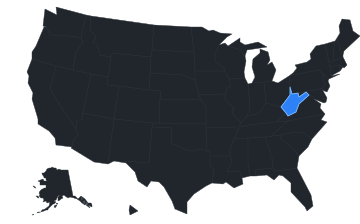
What companies in West Virginia need to know about AI compliance
As of 2026-07-12, West Virginia has not enacted an AI-specific statute; the West Virginia Attorney General office defers to no comprehensive privacy statute; UDAP coverage via W. Va. Code sec. 46A-6-104. Operators across sectors in West Virginia watch federal signals first.
Because West Virginia has no dedicated AI statute, regulatory obligations fall back to no comprehensive privacy statute layered with federal sector-specific rules.
Three neighboring regimes create compounding exposure: Pennsylvania (HB 1598 (2023-24) — AI-generated content disclosure (reintroduced as HB 95, 2025-26), penalty TBD), Ohio (AI Task Force Recommendations, penalty TBD), and Kentucky (AI Study Resolution, penalty TBD). Multi-state Cross-Sector operators headquartered in West Virginia default to the strictest stack.
Federal law still governs Cross-Sector AI in West Virginia primarily through FTC Section 5 (15 USC 45) and NIST AI RMF 1.0. Adjacent federal authorities include Gramm-Leach-Bliley Act (GLBA) / NIST Cybersecurity Framework (15 U.S.C. § 6801-6809; NIST CSF 2.0); General Data Protection Regulation (GDPR) (for EU users) (EU Regulation 2016/679); Section 508 / ADA Title III (Digital Accessibility) (29 U.S.C. § 794(d); 42 U.S.C. § 12181). Gramm-Leach-Bliley Act (GLBA) / NIST Cybersecurity Framework (enforced by Federal Trade Commission; NIST) applies to saas platforms handling personal/financial data via ai must implement nist csf security standards: identify, protect, detect, respond, recover. Penalty exposure: ftc civil penalties up to $100,000/violation; private litigation for data breaches. FTC Operation AI Comply (Sep 2024) targeted five companies across sectors.
The enforcement surface for Cross-Sector centres on FTC, CFPB, State Attorneys General, and the statute operators most often under-document is General Data Protection Regulation (GDPR) (for EU users) (EU Regulation 2016/679) — a gap that surfaces in cross-sector FTC Section 5 exposure disputes. Build an evidence binder covering AI inventory, risk-tier register, incident-response runbook, and board-level AI risk report. Treat NIST AI RMF 1.0 (Jan 2023) is cited as the federal baseline across 30+ agency guidance documents as your leading indicator and escalate when the signal shifts.
The federal and neighboring-state framework that governs your AI operations. Cross-Sector operators in West Virginia operate under a federal-dominant framework anchored by FTC Section 5 (15 USC 45) and NIST AI RMF 1.0, with adjacent authorities Gramm-Leach-Bliley Act (GLBA) / NIST Cybersecurity Framework (15 U.S.C. § 6801-6809; NIST CSF 2.0); General Data Protection Regulation (GDPR) (for EU users) (EU Regulation 2016/679); Section 508 / ADA Title III (Digital Accessibility) (29 U.S.C. § 794(d); 42 U.S.C. § 12181). FTC Operation AI Comply (Sep 2024) targeted five companies across sectors. The practical risk they have to price in is cross-sector FTC Section 5 exposure and state UDAP liability, and the bellwether signal to monitor is NIST AI RMF 1.0 (Jan 2023) is cited as the federal baseline across 30+ agency guidance documents. Pennsylvania -- HB 1598 (2023-24) — AI-generated content disclosure (reintroduced as HB 95, 2025-26) sets the de-facto regional floor. West Virginia has not enacted comprehensive AI legislation; AI oversight remains at the study and task-force stage. Use this as a starting point; sector pages on this site go deeper into industry-specific obligations.
With 11-50 employees you can justify a half-time compliance lead and part-time external counsel on retainer. Small-stage Cross-Sector operators should deploy a named compliance lead, formal AI inventory, quarterly bias spot-checks, and a documented escalation path, with semi-annual internal audit with annual external review and ownership resting with a designated AI compliance lead reporting to the CEO. small-business budgets ($50K-$250K) justify a compliance lead plus a GRC tool such as Credo AI, Fairly, or Holistic AI. For Cross-Sector specifically, the sharpest exposure to manage is cross-sector FTC Section 5 exposure and state UDAP liability. Given West Virginia's concentration in energy transition, healthcare, and manufacturing, energy-grid AI and algorithmic adjudication in workers compensation claims deserve priority in your AI inventory.
Verified 2026-07-12. See https://www.wvlegislature.gov/ for the West Virginia Attorney General public record on West Virginia AI policy.
No state AI law — but this federal framework still applies in West Virginia
West Virginia has not enacted its own AI-specific statute. That does not mean AI is unregulated here: the U.S. federal framework below is in force in West Virginia exactly as it is in every other state. Each authority links to its official government source. This is the cross-sector baseline — see the federal AI tracker for bills moving through Congress, and the industry pages below for sector-specific obligations.
Prohibits unfair or deceptive acts or practices in or affecting commerce. AI-generated marketing content that deceives consumers — synthetic testimonials, undisclosed AI-created imagery, deceptive personalization, dark patterns amplified by AI — is actionable under Section 5.
AI hiring and performance monitoring systems must accommodate individuals with disabilities. Must not eliminate essential job functions or require unnecessary testing.
AI credit and background check systems used in rental decisions must be transparent and non-discriminatory.
Voluntary framework organizing AI risk into Govern, Map, Measure, and Manage functions. A manufacturing-focused profile is under development. Framework is referenced in federal-contractor expectations and in agency best-practice guidance.
Recent AI law developments in West Virginia
Updated August 29, 2026Recent news coverage of AI regulation and policy in West Virginia. Headlines are aggregated automatically; follow each link for the full story.

AI bills moving through the West Virginia legislature
Updated August 30, 2026AI-related bills currently tracked in the West Virginia legislature, updated automatically from Open States and the state legislature's own official record. Follow each link for the official bill text, sponsors, and status history.
To House Finance
To House Rules
To House Judiciary
Chapter 38, Acts, Regular Session, 2025
To House Rules
Referred to Rules on 1st reading
Applicable laws
West Virginia AI compliance by industry
AI compliance by company size
Jump to top-risk sectors for your company size
Quick resources for West Virginia
Industry risk levels in West Virginia
Do you also serve EU customers?
The EU AI Act applies to any company serving EU customers, even if you're based in West Virginia. Penalties reach €35M or 7% of global revenue. Deadline: August 2, 2026.
Other states with active AI laws
Anchored to the primary government source (statute, bill text, or agency rule) and verified directly against it · Last verified Jul 12, 2026. See our methodology.
- ↗wvlegislature.govhttps://www.wvlegislature.gov/