 Vetoed
AI Laws in Virginia (VA)
HB 2094 would have required high-risk AI developers to implement safeguards against algorithmic discrimination. Governor Youngkin vetoed the bill on March 24, 2025; no dedicated AI law currently in effect.
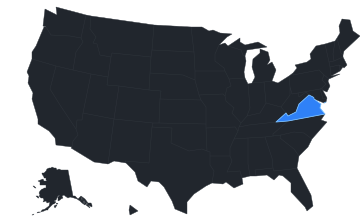
What HB 2094 requires
Virginia has enacted HB 2094 — High-Risk AI Developer and Deployer Act (vetoed 2025-03-24). HB 2094 would have required high-risk AI developers to implement safeguards against algorithmic discrimination. Governor Youngkin vetoed the bill on March 24, 2025; no dedicated AI law currently in effect. This page explains what the law requires in plain language, who is in scope, the penalty for non-compliance, and what your business needs to do before the N/A (vetoed) deadline.
Who is in scope
The law covers developers who build AI systems classified as high-risk — typically systems that influence consequential decisions in credit, employment, healthcare, education, housing, or government services — and the companies that deploy them, and any operator deploying AI systems that interact with consumers, influence decision-making, or could produce discriminatory outcomes in housing, credit, employment, or public accommodations. Company size does not determine whether you are in scope — a startup with ten employees using an off-the-shelf AI hiring tool has the same disclosure obligations as an enterprise running a custom-built model. What matters is whether the AI system makes or substantially informs a decision that affects a Virginia resident in a consequential way. Notably, the obligation extends to vendors: if your company deploys an AI tool built by a third party, you — as the deployer — are responsible for ensuring it meets Virginia's requirements, even if you did not build it.
Key compliance requirements
Virginia's risk-assessment framework requires that developers and deployers of high-impact AI systems conduct formal impact assessments before deployment and re-evaluate them when the system changes materially. An impact assessment must document the intended purpose of the system, the data it uses, the populations it affects, known accuracy limitations, and what bias-testing was performed. Deployers must also publish a summary of the assessment that is accessible to consumers and regulators — internal documentation alone is insufficient. Critically, the assessment is not a one-time exercise: Virginia's law contemplates ongoing monitoring, with a duty to update documentation when performance data or demographic outputs shift.
Virginia's law specifically targets AI systems designed to manipulate human behavior or produce discriminatory outcomes. A system is considered manipulative if it exploits psychological biases, creates false urgency, or targets vulnerable populations in ways that undermine informed consent. The anti-discrimination provisions extend existing civil-rights frameworks into AI: companies cannot deploy AI that produces disparate outcomes in protected categories even if no discriminatory intent existed. This requires testing AI outputs across demographic groups before deployment and building ongoing monitoring into the operational pipeline.
Penalties for non-compliance
The financial consequences of non-compliance under HB 2094 are real and enforceable now. Virginia sets a maximum civil penalty of N/A (vetoed). Penalties accumulate per violation — meaning a company that has deployed an AI tool to thousands of consumers without required disclosures faces compounding exposure, not a single capped fine. Consumer AI violations in Virginia may also attract federal coordination: the FTC's Operation AI Comply sweep (September 2024) demonstrated that state and federal enforcers share intelligence on companies with widespread AI disclosure failures.
What to do now
Build your AI inventory first. You cannot comply with Virginia's requirements if you do not know which systems are in scope. Map every AI or automated decision system your company uses that touches Virginia residents — including third-party vendor tools integrated into your product.
Draft accurate disclosure language. Work with legal counsel to produce disclosure statements that accurately describe what your AI does, what data it uses, and what the consumer can do if they want human review. Vague or boilerplate disclosures will not satisfy Virginia's requirements.
Build the opt-out pathway. Implement a functioning process for consumers to request human review or opt out of AI-assisted processing. Test it before the deadline — regulators will look for live, working mechanisms, not documented promises.
Complete impact assessments for high-risk systems. Follow the framework in HB 2094 to produce a written assessment covering intended use, training data, affected populations, accuracy benchmarks, and bias mitigation. Retain the documentation for at least the period specified in the law's record-keeping provisions.
Assign a compliance owner. Designate someone — legal counsel, a privacy officer, or a dedicated AI governance lead — to track regulatory developments, own the audit documentation, and respond if an enforcement inquiry arrives. The compliance deadline is N/A (vetoed). Don't wait until the deadline to start.
Virginia AI law in the broader regulatory landscape
Virginia's law does not exist in isolation. The trend across the United States is toward more regulation, not less: at least 20 states enacted or proposed AI-specific legislation in 2025 alone, and federal enforcement agencies — the FTC, EEOC, CFPB, and HHS — have all issued guidance making clear that existing laws apply to AI systems even where no AI-specific statute exists. Companies doing business across state lines must track each state's requirements independently — there is no federal preemption that would allow a company to satisfy Virginia's law and automatically comply with requirements in Illinois, Colorado, or New York.
Recent AI law developments in Virginia
Updated August 26, 2026Recent news coverage of AI regulation and policy in Virginia. Headlines are aggregated automatically; follow each link for the full story.

Coverage from Virginia Lawyers Weekly on AI legislation and regulation relevant to Virginia.

Coverage from The Alexandria Brief on AI legislation and regulation relevant to Virginia.
AI bills moving through the Virginia legislature
Updated August 31, 2026AI-related bills currently tracked in the Virginia legislature, updated automatically from Open States and the state legislature's own official record. Follow each link for the official bill text, sponsors, and status history.
Use of artificial intelligence system by mental health service providers; civil penalty. Permits the use of an artificial intelligence system by mental health service providers to assist in providing therapy or counseling services if such mental health service provider maintains full responsibility for all interacti…
Continued from last session
Artificial Intelligence Chatbots Act established; prohibited practices; penalties. Creates the Artificial Intelligence Chatbots Act, which prohibits an operator from making a companion chatbot, as those terms are defined in the bill, available to a user in the Commonwealth unless the companion chatbot is incapable o…
Continued from last session
Artificial Intelligence Chatbots and Minors Act established; enforcement; civil penalties; individual action. Creates the Artificial Intelligence Chatbots and Minors Act to require a covered entity, defined in the bill, to (i) implement certain reasonable systems and processes, (ii) make reasonable efforts to notify…
Continued from last session
Fostering Access, Innovation, and Responsibility in Artificial Intelligence Act established. Establishes the Fostering Access, Innovation, and Responsibility in Artificial Intelligence Act (FAIR AI Act) that requires a developer of a base artificial intelligence model, as defined in the bill, to clearly and conspicu…
Continued from last session
Use of artificial intelligence-based tools; covered artificial intelligence; disclosure of use. Requires the use of covered artificial intelligence, as defined in the bill, in a criminal investigation to be disclosed in a police report filed for that investigation. Such a report shall be submitted to the attorney fo…
Continued from last session
Health carriers; use of artificial intelligence; disclosures. Requires health carriers to disclose to the State Corporation Commission's Bureau of Insurance how artificial intelligence is used to manage claims coverage and to submit all information enabling decisions made by artificial intelligence to the Bureau upo…
Continued from last session
Law enforcement; artificial intelligence inventory; civil action. Requires all law-enforcement agencies, defined in the bill as any state or local law-enforcement agency or sheriff's department, to conduct an inventory of any covered artificial intelligence system, defined in the bill, used by such agency and to mak…
Continued from last session
Department of Education; artificial intelligence system use in instructional settings; development of AIS safety guidance required; AIS Innovation in Education Pilot Program established; report. Requires the Department of Education, in consultation with school divisions and other relevant stakeholders, to compile in…
Approved by Governor-Chapter 943 (effective 7/1/2026)
Department of Education; artificial intelligence system use in instructional settings; development of AIS safety guidance required; AIS Innovation in Education Pilot Program established; report. Requires the Department of Education, in consultation with school divisions and other relevant stakeholders, to compile in…
Approved by Governor-Chapter 937 (effective 7/1/2026)
Joint Commission on Technology and Science; artificial intelligence; independent verification organizations. Directs the Joint Commission on Technology and Science (JCOTS) to evaluate the feasibility and impact of developing a framework for any person or entity seeking to act as an independent verification organizat…
Acts of Assembly Chapter text (CHAP0425)
Joint Commission on Technology and Science; artificial intelligence; independent verification organizations. Directs the Joint Commission on Technology and Science (JCOTS) to evaluate the feasibility and impact of developing a framework for any person or entity seeking to act as an independent verification organizat…
Acts of Assembly Chapter text (CHAP0426)
Study; Joint Legislative Audit and Review Commission; artificial intelligence use policies in place at institutions of higher education in the Commonwealth; report. Directs the Joint Legislative Audit and Review Commission (JLARC) to study the artificial intelligence use policies in place at institutions of higher e…
Bill text as passed House and Senate (HJ32ER)
Artificial Intelligence Chatbots and Minors Act established; enforcement; civil penalties; individual action. Creates the Artificial Intelligence Chatbots and Minors Act to require a covered entity, defined in the bill, to (i) implement certain reasonable systems and processes, (ii) make reasonable efforts to notify…
Continued to next session in Communications, Technology and Innovation (Voice Vote)
Use of artificial intelligence system by mental health service providers; civil penalty. Permits the use of an artificial intelligence system by mental health service providers to assist in providing therapy or counseling services if such mental health service provider maintains full responsibility for all interacti…
Continued to next session in Communications, Technology and Innovation (Voice Vote)
Health carriers; use of artificial intelligence; disclosures. Requires health carriers to disclose to the State Corporation Commission's Bureau of Insurance how artificial intelligence is used to manage claims coverage and to submit all information enabling decisions made by artificial intelligence to the Bureau upo…
Continued to next session in Communications, Technology and Innovation (Voice Vote)
Artificial Intelligence Chatbots and Minors Act established; prohibited practices; penalties. Creates the Artificial Intelligence Chatbots and Minors Act to require that deployers that operate or distribute a chatbot in the Commonwealth (i) ensure that any chatbot operated or distributed by the deployer does not mak…
Left in Committee Communications, Technology and Innovation
Use of artificial intelligence system by mental health service providers; civil penalty. Permits the use of an artificial intelligence system by mental health service providers for administrative support and supplementary support, as those terms are defined in the bill, and prohibits the use of an artificial intelli…
Left in Committee Communications, Technology and Innovation
Artificial Intelligence Workforce Impact Act established; report. Establishes reporting requirements for each state agency in the Commonwealth relating to the impact of artificial intelligence on the workforce. The bill requires each agency to submit quarterly reports to the Department of Human Resource Management d…
Left in Committee Appropriations
Fostering Access, Innovation, and Responsibility in Artificial Intelligence Act established. Establishes the Fostering Access, Innovation, and Responsibility in Artificial Intelligence Act (FAIR AI Act) that requires a developer of a base artificial intelligence model, as defined in the bill, to clearly and conspicu…
Left in Committee Appropriations
Employment decisions; automated decision systems; civil penalty. Provides that the Director of the Department of Human Resource Management shall require any state agency that uses an automated decision system as a substantial factor in any employment decision, as those terms are defined in the bill, to (i) ensure th…
Left in Committee Appropriations
Applicable laws
↗ Each law links to its primary government source. Full source list below.
Virginia AI compliance by industry
AI compliance by company size
Jump to top-risk sectors for your company size
Quick resources for Virginia
Industry risk levels in Virginia
Do you also serve EU customers?
The EU AI Act applies to any company serving EU customers, even if you're based in Virginia. Penalties reach €35M or 7% of global revenue. Deadline: August 2, 2026.
Other states with active AI laws
Anchored to the primary government source (statute, bill text, or agency rule) and verified directly against it · Last verified Apr 22, 2026. See our methodology.
- ↗lis.virginia.govhttps://lis.virginia.gov/cgi-bin/legp604.exe?241+ful+CHAP0002
- ↗mooreandvanallen.comhttps://www.mooreandvanallen.com/insights/virginia-governor-vetoes-high-risk-…