 Executive Order
AI Laws in Alabama (AL)
State agencies required to adopt AI governance policies. Private sector guidance pending.
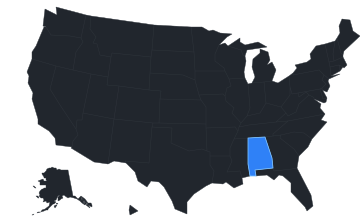
What Executive Order on AI requires
Alabama has enacted Executive Order on AI. State agencies required to adopt AI governance policies. Private sector guidance pending. This page explains what the law requires in plain language, who is in scope, the penalty for non-compliance, and what your business needs to do before the Ongoing deadline.
Who is in scope
The law covers Alabama state agencies that deploy AI for benefits determination, licensing, law enforcement, or public-service delivery; private-sector operators serving state contracts are also in scope. Company size does not determine whether you are in scope — a startup with ten employees using an off-the-shelf AI hiring tool has the same disclosure obligations as an enterprise running a custom-built model. What matters is whether the AI system makes or substantially informs a decision that affects a Alabama resident in a consequential way. Notably, the obligation extends to vendors: if your company deploys an AI tool built by a third party, you — as the deployer — are responsible for ensuring it meets Alabama's requirements, even if you did not build it.
Key compliance requirements
Alabama's AI law for public-sector systems requires state agencies to create and maintain an inventory of every AI tool used in government operations. Each entry in the inventory must describe the system's purpose, the decisions it informs, the data inputs, and the vendor or developer responsible for it. Agencies must also establish an appeals process so that individuals affected by an AI-assisted decision can request human review. For private-sector companies that provide AI tools to the state, contract language must address these transparency and accountability obligations — vendors who cannot demonstrate compliance may be excluded from procurement.
Penalties for non-compliance
The financial consequences of non-compliance under Executive Order on AI are real and enforceable now. Alabama sets a maximum civil penalty of N/A (Executive). Penalties accumulate per violation — meaning a company that has deployed an AI tool to thousands of consumers without required disclosures faces compounding exposure, not a single capped fine.
What to do now
Build your AI inventory first. You cannot comply with Alabama's requirements if you do not know which systems are in scope. Map every AI or automated decision system your company uses that touches Alabama residents — including third-party vendor tools integrated into your product.
Review government contracts. If your company provides AI tools to Alabama state agencies, review pending and existing contracts to ensure they address the inventory, transparency, and appeals requirements that now flow through to vendors.
Assign a compliance owner. Designate someone — legal counsel, a privacy officer, or a dedicated AI governance lead — to track regulatory developments, own the audit documentation, and respond if an enforcement inquiry arrives. The compliance deadline is Ongoing. Don't wait until the deadline to start.
Alabama AI law in the broader regulatory landscape
Alabama's law does not exist in isolation. The trend across the United States is toward more regulation, not less: at least 20 states enacted or proposed AI-specific legislation in 2025 alone, and federal enforcement agencies — the FTC, EEOC, CFPB, and HHS — have all issued guidance making clear that existing laws apply to AI systems even where no AI-specific statute exists. Companies doing business across state lines must track each state's requirements independently — there is no federal preemption that would allow a company to satisfy Alabama's law and automatically comply with requirements in Illinois, Colorado, or New York.
Recent AI law developments in Alabama
Updated August 25, 2026Recent news coverage of AI regulation and policy in Alabama. Headlines are aggregated automatically; follow each link for the full story.

Coverage from The National Law Review on AI legislation and regulation relevant to Alabama.

Coverage from Reuters on AI legislation and regulation relevant to Alabama.

Coverage from fox10tv.com on AI legislation and regulation relevant to Alabama.

Coverage from Alabama Reflector on AI legislation and regulation relevant to Alabama.

Coverage from WBMA on AI legislation and regulation relevant to Alabama.
AI bills moving through the Alabama legislature
Updated August 30, 2026AI-related bills currently tracked in the Alabama legislature, updated automatically from Open States and the state legislature's own official record. Follow each link for the official bill text, sponsors, and status history.
Insurance
Enacted
Authorities, Boards, & Commissions
Enacted
Resolutions
Enacted
Government Administration
Read for the first time and referred to the House Committee on State Government
Government Administration
Read for the first time and referred to the Senate Committee on Fiscal Responsibility and Economic Development
Consumer Protection
Read for the first time and referred to the House Committee on Judiciary
Consumer Protection
Read for the first time and referred to the House Committee on Judiciary
Consumer Protection
Read for the first time and referred to the Senate Committee on Judiciary
Applicable laws
↗ Each law links to its primary government source. Full source list below.
Alabama AI compliance by industry
AI compliance by company size
Jump to top-risk sectors for your company size
Quick resources for Alabama
Industry risk levels in Alabama
Do you also serve EU customers?
The EU AI Act applies to any company serving EU customers, even if you're based in Alabama. Penalties reach €35M or 7% of global revenue. Deadline: August 2, 2026.
Other states with active AI laws
Anchored to the primary government source (statute, bill text, or agency rule) and verified directly against it · Last verified Jul 11, 2026. See our methodology.
- ↗governor.alabama.govhttps://governor.alabama.gov/