 No Law
AI Laws in Maryland (MD)
Maryland has not enacted a comprehensive private-sector AI law. The Artificial Intelligence Governance Act of 2024 (SB 818) directs the Department of Information Technology to set policies for and inventory AI used by state-government units, but imposes no direct private-sector compliance duty. Existing anti-discrimination and consumer-protection laws may apply to AI-driven decisions.
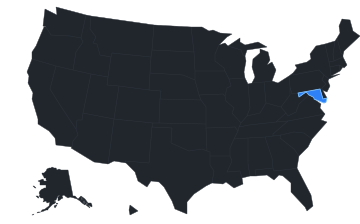
What companies in Maryland need to know about AI compliance
Maryland remains in the "no dedicated AI law" cohort as of 2026-07-04 — maryland enacted the artificial intelligence governance act of 2024 (sb 818) governing state-government ai use, plus deepfake laws, but no comprehensive private-sector ai statute. Operators across sectors in Maryland watch federal signals first.
Maryland's non-legislation on AI means the Maryland Attorney General office has discretion to apply Maryland Online Data Privacy Act (2024) with a profiling opt-out to AI-driven consumer harms as they arise.
The federal and neighboring-state framework that governs your AI operations. Cross-Sector operators in Maryland operate under a federal-dominant framework anchored by FTC Section 5 (15 USC 45) and NIST AI RMF 1.0, with adjacent authorities Gramm-Leach-Bliley Act (GLBA) / NIST Cybersecurity Framework (15 U.S.C. § 6801-6809; NIST CSF 2.0); General Data Protection Regulation (GDPR) (for EU users) (EU Regulation 2016/679); Section 508 / ADA Title III (Digital Accessibility) (29 U.S.C. § 794(d); 42 U.S.C. § 12181). FTC Operation AI Comply (Sep 2024) targeted five companies across sectors. The practical risk they have to price in is cross-sector FTC Section 5 exposure and state UDAP liability, and the bellwether signal to monitor is NIST AI RMF 1.0 (Jan 2023) is cited as the federal baseline across 30+ agency guidance documents. No regional statute applies yet. Maryland enacted the Artificial Intelligence Governance Act of 2024 (SB 818) governing state-government AI use, plus deepfake laws, but no comprehensive private-sector AI statute. Use this as a starting point; sector pages on this site go deeper into industry-specific obligations.
Federal law still governs Cross-Sector AI in Maryland primarily through FTC Section 5 (15 USC 45) and NIST AI RMF 1.0. Adjacent federal authorities include Gramm-Leach-Bliley Act (GLBA) / NIST Cybersecurity Framework (15 U.S.C. § 6801-6809; NIST CSF 2.0); General Data Protection Regulation (GDPR) (for EU users) (EU Regulation 2016/679); Section 508 / ADA Title III (Digital Accessibility) (29 U.S.C. § 794(d); 42 U.S.C. § 12181). Gramm-Leach-Bliley Act (GLBA) / NIST Cybersecurity Framework (enforced by Federal Trade Commission; NIST) applies to saas platforms handling personal/financial data via ai must implement nist csf security standards: identify, protect, detect, respond, recover. Penalty exposure: ftc civil penalties up to $100,000/violation; private litigation for data breaches. FTC Operation AI Comply (Sep 2024) targeted five companies across sectors.
Maryland's immediate neighbors also lack AI-specific statutes, so operators defer primarily to federal frameworks until regional precedent emerges.
The enforcement surface for Cross-Sector centres on FTC, CFPB, State Attorneys General, and the statute operators most often under-document is General Data Protection Regulation (GDPR) (for EU users) (EU Regulation 2016/679) — a gap that surfaces in cross-sector FTC Section 5 exposure disputes. Build an evidence binder covering AI inventory, risk-tier register, incident-response runbook, and board-level AI risk report. Treat NIST AI RMF 1.0 (Jan 2023) is cited as the federal baseline across 30+ agency guidance documents as your leading indicator and escalate when the signal shifts.
With 11-50 employees you can justify a half-time compliance lead and part-time external counsel on retainer. Small-stage Cross-Sector operators should deploy a named compliance lead, formal AI inventory, quarterly bias spot-checks, and a documented escalation path, with semi-annual internal audit with annual external review and ownership resting with a designated AI compliance lead reporting to the CEO. small-business budgets ($50K-$250K) justify a compliance lead plus a GRC tool such as Credo AI, Fairly, or Holistic AI. For Cross-Sector specifically, the sharpest exposure to manage is cross-sector FTC Section 5 exposure and state UDAP liability. Given Maryland's concentration in federal contracting, biotechnology and healthcare, and financial services, government-contractor AI systems and automated hiring tools deserve priority in your AI inventory.
Verified 2026-07-04. See https://mgaleg.maryland.gov/mgawebsite/Legislation/Details/SB0818?ys=2024RS for the Maryland Attorney General public record on Maryland AI policy.
No state AI law — but this federal framework still applies in Maryland
Maryland has not enacted its own AI-specific statute. That does not mean AI is unregulated here: the U.S. federal framework below is in force in Maryland exactly as it is in every other state. Each authority links to its official government source. This is the cross-sector baseline — see the federal AI tracker for bills moving through Congress, and the industry pages below for sector-specific obligations.
Prohibits unfair or deceptive acts or practices in or affecting commerce. AI-generated marketing content that deceives consumers — synthetic testimonials, undisclosed AI-created imagery, deceptive personalization, dark patterns amplified by AI — is actionable under Section 5.
AI hiring and performance monitoring systems must accommodate individuals with disabilities. Must not eliminate essential job functions or require unnecessary testing.
AI credit and background check systems used in rental decisions must be transparent and non-discriminatory.
Voluntary framework organizing AI risk into Govern, Map, Measure, and Manage functions. A manufacturing-focused profile is under development. Framework is referenced in federal-contractor expectations and in agency best-practice guidance.
Recent AI law developments in Maryland
Updated August 26, 2026Recent news coverage of AI regulation and policy in Maryland. Headlines are aggregated automatically; follow each link for the full story.

Coverage from Maryland Daily Record on AI legislation and regulation relevant to Maryland.

Coverage from Maryland Daily Record on AI legislation and regulation relevant to Maryland.

Coverage from Jurist.org on AI legislation and regulation relevant to Maryland.
AI bills moving through the Maryland legislature
Updated August 31, 2026AI-related bills currently tracked in the Maryland legislature, updated automatically from Open States and the state legislature's own official record. Follow each link for the official bill text, sponsors, and status history.
Approved by the Governor - Chapter 633
Approved by the Governor - Chapter 634
Approved by the Governor - Chapter 445
Approved by the Governor - Chapter 444
Referred Rules
Establishing the Maryland 3-1-1 Oversight Board in the Maryland Information Network to oversee the expansion of 3-1-1 systems in Maryland; establishing the 3-1-1 Program to use certain artificial intelligence to answer certain questions and route certain calls in certain counties; and requiring creation and implementation of a plan to expand the 3-1-1 Program to all of the counties in Maryland after a certain time period.
Approved by the Governor - Chapter 434
Referred Rules
Prohibiting a food retailer and a third-party delivery service provider from engaging in the practice of dynamic pricing or using consumer personal data to set a price for consumer goods or services; prohibiting a food retailer and a third-party delivery service provider from using protected class data to offer, advertise, or sell a consumer good or service under certain circumstances; making a certain violation of the Act an unfair, abusive, or deceptive trade practice that is subject to enforcement and penalties; etc.
Approved by the Governor - Chapter 154
Authorizing the State Lottery and Gaming Control Commission, in collaboration with Bowie State University, Morgan State University, and the Maryland Center of Excellence on Problem Gambling, to conduct certain studies that identify certain trends and emerging technology to create a safe and transparent gambling environment; and establishing the Workgroup on Gambling Prevention Technology in the Commission to study certain best practices to ascertain the extent of problem gambling on college campuses in the State.
In the Senate - Third Reading Passed with Amendments (43-0)
Requiring Prince George's Community College, in consultation with certain entities, to conduct a comprehensive feasibility study and program design assessment for aerospace and aviation systems technology workforce training programs; requiring Prince George's Community College to report the results of the feasibility study to certain committees of the General Assembly by December 1, 2027; and requiring the Governor to include $100,000 in the 2028 annual budget bill for Prince George's Community College to complete the study.
Approved by the Governor - Chapter 784
Establishing the Maryland's Future Board under the Department of Commerce to develop, evaluate, and revise a visionary plan for the future of Maryland by January 1, 2027, and make recommendations for projects based on the plan to the Governor and the General Assembly; establishing the Maryland's Future Fund to fund projects recommended by the Board; and requiring the Comptroller to submit a report on economic growth trends in the State to the General Assembly by December 1, 2026.
Approved by the Governor - Chapter 377
Establishing the Maryland's Future Board under the Department of Commerce to develop, evaluate, and revise a visionary plan for the future of Maryland by January 1, 2027; requiring the Board to make recommendations for projects based on the plan to the Governor and the General Assembly by August 1, 2027 and each August 1 thereafter; establishing the Maryland's Future Fund; and requiring the Comptroller to study economic growth trends for certain industries and report to the General Assembly by December 1, 2026.
Approved by the Governor - Chapter 378
Establishing the Division of Data Protection within the Office of the Attorney General to investigate and bring civil actions related to violations; establishing the Maryland Data Privacy Implementation and Innovation Workgroup to study Maryland's consumer data privacy framework and evaluate implementation issues; and requiring the Workgroup to report its findings and recommendations to the Governor and the General Assembly by January 1, 2027.
In the House - First Reading House Rules and Executive Nominations
Hearing 4/01 at 1:00 p.m.
Hearing 3/26 at 1:00 p.m.
Requiring certain operators of companion chatbots to establish, maintain, and publish certain protocols and provide certain information to users of the companion chatbot; requiring operators to establish enhanced measures for minor users of companion chatbots; limiting the amount and type of data an operator may collect; requiring an operator to establish and maintain a complaint system; requiring the Office of Suicide Prevention to annually publish certain data compiled from operators; etc.
In the Senate - Hearing 3/26 at 1:00 p.m.
Prohibiting a food retailer and a third-party food delivery service provider from engaging in the practice of dynamic pricing or using consumer data to set a price for consumer goods or services; prohibiting a food retailer and a third-party food delivery service provider from using protected class data to offer, advertise, or sell a consumer good or service under certain circumstances; making a violation of the Act an unfair, abusive, or deceptive trade practice that is subject to certain enforcement and penalties; etc.
In the House - Hearing 3/31 at 1:00 p.m.
Prohibiting behavioral health care providers from using artificial intelligence to provide behavioral health care to a patient; authorizing a behavioral health care provider to use a system that employs artificial intelligence in performing administrative support tasks under certain circumstances; and requiring a behavioral health care provider to obtain certain informed consent from patients if the provider uses a certain system that employs artificial intelligence under certain circumstances.
In the House - Unfavorable Report by Health; Withdrawn
Establishing a rebuttable presumption that a social media platform has made an independent expenditure to a certain candidate if the social media platform knowingly and purposefully alters its algorithm to amplify certain political content for the benefit of the candidate; prohibiting a foreign national from using a bot to publish, distribute, or disseminate campaign material or artificially amplify political content to users of an online platform for a certain purpose; etc.
In the House - Hearing 4/01 at 1:00 p.m.
Establishing the position and responsibilities of the State Chief Data Officer; establishing the Office of Enterprise Data in the Department of Information Technology and the responsibilities of the Office; and requiring certain units of State government and authorizing certain units of State government to appoint an Agency Data Officer and establishing the responsibilities of Agency Data Officers.
In the House - Unfavorable Report by Government, Labor, and Elections; Withdrawn
Requiring that a carrier's internal grievance process provide for human review of grievances resulting from adverse decisions made using artificial intelligence, algorithm, or other software tools; requiring carriers to report certain information on grievances resulting from adverse decisions made using artificial intelligence, algorithm, or other software tools; requiring a carrier to provide a model review process under certain circumstances; etc.
In the House - Unfavorable Report by Health; Withdrawn
Hearing 2/27 at 1:00 p.m.
Hearing 3/03 at 1:00 p.m.
Prohibiting certain conduct relating to child exploitation material; establishing a civil action for a certain violation of the Act; authorizing the Attorney General to enforce certain provisions of the Act; defining "computer-generated image" in certain provisions relating to crimes involving child pornography to include an image created through the use of artificial intelligence software; and increasing from 16 to 18 the requisite age of a child considered to be a victim of certain child pornography crimes.
In the Senate - First Reading Senate Rules
Requiring employers with 100 or more employees that reduced their workforce in the State by a least 10 employees while using automation technology to submit certain information to the Secretary of Labor concerning the number of employees employed, automation technology deployed or used, and certain employees separated from employment during the immediately preceding calendar year; requiring a certain covered employer to pay a certain assessment for each displaced employee reported by the covered employer; etc.
In the House - Unfavorable Report by Economic Matters; Withdrawn
Applicable laws
Maryland AI compliance by industry
AI compliance by company size
Jump to top-risk sectors for your company size
Quick resources for Maryland
Industry risk levels in Maryland
Do you also serve EU customers?
The EU AI Act applies to any company serving EU customers, even if you're based in Maryland. Penalties reach €35M or 7% of global revenue. Deadline: August 2, 2026.
Other states with active AI laws
Anchored to the primary government source (statute, bill text, or agency rule) and verified directly against it · Last verified Jul 4, 2026. See our methodology.
- ↗mgaleg.maryland.govhttps://mgaleg.maryland.gov/mgawebsite/Legislation/Details/SB0818?ys=2024RS